
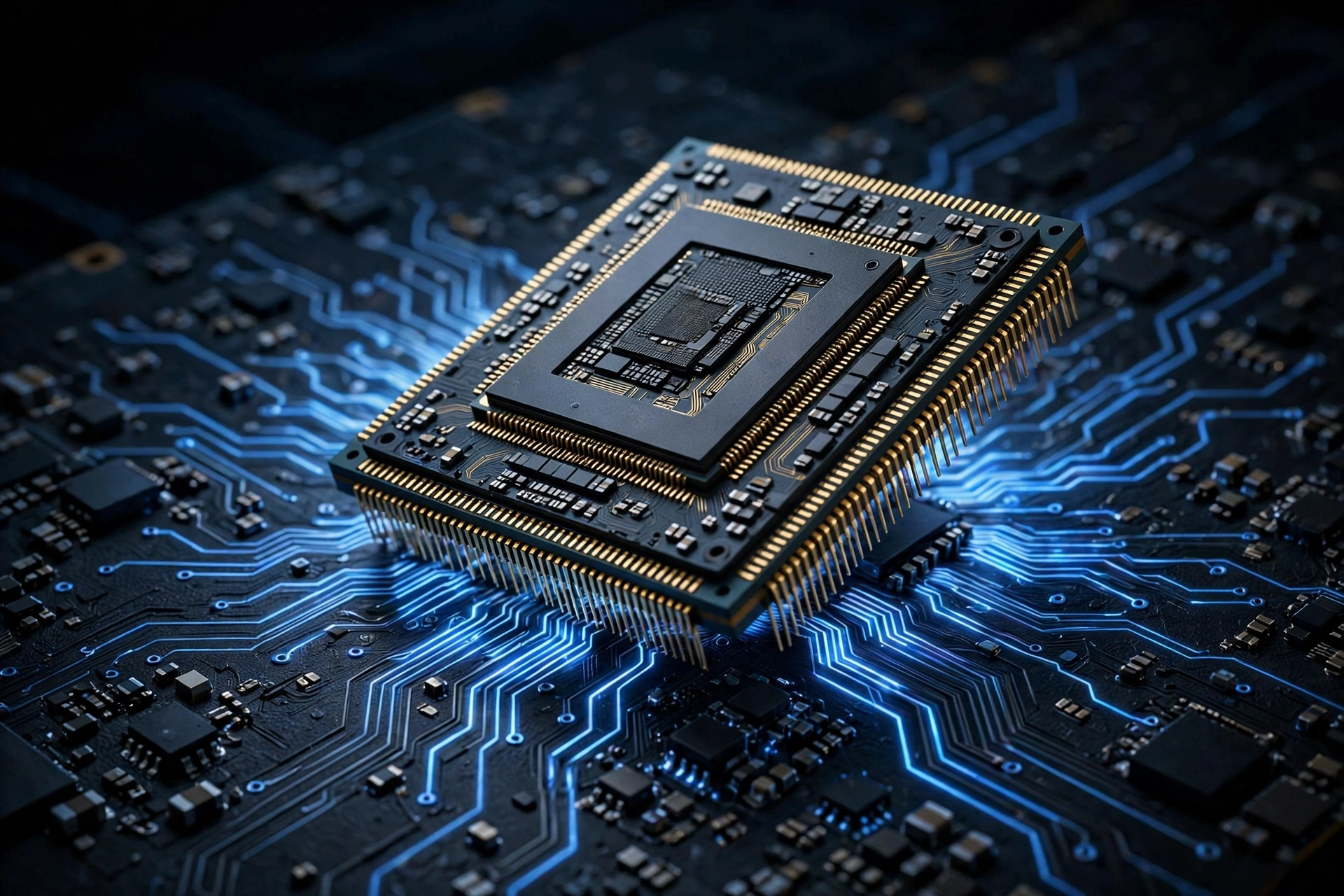
Snapdragon 8 Gen 5 is Qualcomm’s second premium phone chip, announced on November 26, 2025, and built by TSMC on a 3-nanometer process. It sits below the Snapdragon 8 Elite Gen 5, uses the same Oryon CPU design at lower clocks, and keeps a smaller cache, a cut-down GPU, and slower memory.
Qualcomm positioned the chip for flagship-adjacent phones, according to NotebookCheck. That positioning is the key to reading every score below. Lower clocks and a cut-down GPU can still deliver fast daily performance, while the Elite chip keeps a clear lead where the GPU is pushed.
The claims Qualcomm made for Snapdragon 8 Gen 5 at launch were measured against the older Snapdragon 8 Gen 3, not the Elite Gen 5. FoneArena’s report cites company figures of 36% better CPU, 76% better web browsing, 11% better GPU, and 46% faster NPU performance than the Gen 3. Those are manufacturer claims, labelled (MF).
Snapdragon 8 Gen 5 in Brief
- Position: a premium tier below the Snapdragon 8 Elite Gen 5, for phones that aim near flagship speed without the flagship chip.
- CPU: 8 cores, with 2 Oryon Prime cores at up to 3.8GHz and 6 Oryon Performance cores at up to 3.32GHz.
- GPU: Adreno 840 as marketed by Qualcomm, listed as Adreno 829 in benchmark databases, at up to 1,225MHz in the NanoReview listing.
- Modem and wireless: Snapdragon X80 5G modem, Wi-Fi 7, Bluetooth 6.0, and Ultra Wideband through the FastConnect 7900 system.
- Scores are NanoReview crowd aggregates (CR) from different phones. Snapdragon 8 Gen 5 has no lab-reviewer score in the sources checked, and no phone price was verified.
Why the Snapdragon 8 Gen 5 Matters for Buyers
The chip matters because it decides what a whole class of 2026 phones can do. FoneArena reported planned devices from iQOO, Honor, Meizu, Motorola, OnePlus, and vivo, and NanoReview’s listing names models from Xiaomi, Lenovo, Realme, Motorola, vivo, and OnePlus.
Naming is the trap. Qualcomm used the same Oryon generation and Adreno 840 marketing name for both chips, while clock speed, cache, GPU slices, and graphics memory differ. Check the exact chip name before buying.
Snapdragon 8 Gen 5 Specs: What Qualcomm Kept and What It Cut
Snapdragon 8 Gen 5 keeps the 2-plus-6 Oryon layout and ARMv9.2-A. NotebookCheck and GizmoChina identify the shared process as TSMC N3P. Prime cores run at up to 3.8GHz and Performance cores at up to 3.32GHz, against NanoReview’s Elite listing of 4.74GHz and 3.63GHz.
The graphics setup is where the cut is sharpest. GSMArena reported that Geekbench listings identify the GPU in Snapdragon 8 Gen 5 as Adreno 829, without the Elite chip’s boost mode or its 18MB of Adreno High-Performance Memory. GizmoChina puts the split at two GPU slices against three, with 2MB of graphics memory here.
Snapdragon 8 Gen 5 supports LPDDR5X at up to 4,800MHz with a listed maximum of 76.8 Gb/s, against 5,300MHz and 84.8 Gb/s for the Elite chip. Both list the same Spectra processor, a camera up to 320MP, and video at 8K at 60fps and 4K at 120fps.
Storage listings differ and are left unresolved here. NanoReview lists UFS 4.0 and UFS 4.1, FoneArena names UFS 4.0 only, and other coverage describes UFS 4.1. The Frame Motion Engine version is unstated: FoneArena lists 2.1, other coverage reports 3.0.

Snapdragon 8 Gen 5 Benchmarks: Crowd Scores, Read Carefully
Every score below is a NanoReview crowd aggregate (CR) from different phones. NanoReview’s chip page lists for Snapdragon 8 Gen 5 an AnTuTu 11 total of 3,057,215, Geekbench 6 at 2,833 single-core and 9,119 multi-core, a Compute score of 21,241, and Solar Bay at 9,094 with Steel Nomad Light at 1,823. No lab-reviewer (LR) score appeared in the sources checked.
Testing note: No published same-chassis lab test exists; treat phone scores as orientation only. Results below come from different retail phones tested by different outlets at different times. They are useful for ballpark comparison, not a controlled duel.
From the NanoReview aggregates, the Elite chip leads Snapdragon 8 Gen 5 by about 28% in Geekbench 6 single-core, about 21% in multi-core, and about 23% in the AnTuTu 11 CPU subscore. The total gap is about 29%. Daily browsing and messaging will not expose a gap of this size as often as multitasking will.
The Elite chip leads Snapdragon 8 Gen 5 by about 41% in the AnTuTu 11 GPU subscore, about 34% in Solar Bay, about 29% in Geekbench 6 Compute, and about 50% in Steel Nomad Light. That matches the hardware cut.
Remember that sustained performance depends on each phone’s cooling, software tuning and ambient temperature as much as on the chip itself. A thicker phone with better vapour chamber can outperform a thinner phone on the same silicon. The PCMark gap, about 47%, rests on fewer than 3 phones against 13 for the Elite chip.
Snapdragon 8 Gen 5 Phones: Scores Vary by Phone
Phone-level results show why the headline aggregate is only a starting point. NanoReview’s AnTuTu v11 listing puts the Xiaomi Redmi K100 Pro Max at 3,722,803, well above the Snapdragon 8 Gen 5 aggregate of 3,057,215, while the OnePlus 15R sits at 3,039,097.
Availability details beyond the listing are thin. FoneArena reported that OnePlus would use Snapdragon 8 Gen 5 first in the OnePlus Ace 6T in China, with the same phone launching globally as the OnePlus 15R, including in India on December 17, 2025. No verified phone price in US dollars or euros was found. Buyers in Bangladesh should expect grey or parallel imports where no official launch exists.

Battery and Charging: No Chip Verdict Here
No measured battery-life result for a named phone with Snapdragon 8 Gen 5 appeared in the sources checked, and no battery evidence table has been invented. Charging speed is a property of the specific phone, its battery size, and its charger, not a number that follows the chip name.
Bottom line on battery: No identical-condition battery duel was found across the reviewed phones. Treat battery life and charging speed as properties of the specific phone (its mAh size, software, screen and charger), not of the chip. Do not pick a chip winner on battery.
Connectivity in Practice: Who Benefits, and Who Will Not Notice
FoneArena lists the Snapdragon X80 with peaks of up to 10Gbps down and 3.5Gbps up, mmWave with 8 carriers, and sub-6GHz with 4×6 MIMO. Wi-Fi 7 through FastConnect 7900 carries a listed peak of 5.8Gbps, with Bluetooth 6.0 and Ultra Wideband. Those are listed maximums, not measured speeds.
The X80 modem in Snapdragon 8 Gen 5 adds mmWave support and the platform supports Wi-Fi 7. In practice that matters mainly for buyers in the US, where Verizon and AT&T operate mmWave networks, and for users who already own a Wi-Fi 7 router. Most buyers in Bangladesh, South Asia, and Europe on sub-6GHz 5G or LTE will see no daily benefit.
The Takeaway: Pick the Phone, Not Just the Chip
Consider a phone with Snapdragon 8 Gen 5 if you want near-flagship daily speed without the most expensive chip, if your heaviest use is browsing, video, messaging, and lighter games, or if the complete phone matters more than its benchmark total. Look toward an Elite Gen 5 phone for sustained high-end gaming.
- Pick the Snapdragon 8 Gen 5 phone if daily speed and the complete phone matter more than the top benchmark total.
- Pick the Elite Gen 5 phone if long gaming sessions and maximum graphics headroom decide the purchase.
- At the same price, prefer the better-reviewed complete phone over the better chip name. If both are equally well reviewed at the same price, the Elite Gen 5 phone is the safer performance pick.
Chip performance is only one factor. Screen quality, camera tuning, battery size, and software updates matter more than a benchmark gap. Do not over-index on specs.
Quick Answers
What is the Snapdragon 8 Gen 5 AnTuTu 11 score?
The NanoReview crowd aggregate (CR) is 3,057,215, with 905,159 for CPU, 1,061,006 for GPU, 388,817 for memory, and 702,233 for UX. Individual phones score higher or lower, as the phone table shows. AnTuTu 12 entries were excluded. The figure is a pooled aggregate, not a lab result.
Is the chip the same as the Snapdragon 8 Elite Gen 5?
No. Snapdragon 8 Gen 5 shares the third-generation Oryon CPU design and a 3-nanometer TSMC process with the Elite chip, but it runs at lower clocks, has a smaller L3 cache, a cut-down GPU with less graphics memory, slower memory, and an X80 modem instead of the X85. Qualcomm markets the GPU in both as Adreno 840, while listings identify the version here as Adreno 829.
Which phones use the chip?
NanoReview’s listing names the Xiaomi Redmi K100 Pro Max, Lenovo Legion Y70 (2026), Realme Neo 8, Motorola Signature, Motorola Edge 70 Max, vivo iQOO Z11 Turbo, vivo iQOO 15R, OnePlus Ace 6T, OnePlus 15R, and vivo S50 Pro mini. Confirm the exact model and variant before buying.
Does it support mmWave 5G and Wi-Fi 7?
FoneArena’s specification list includes mmWave with 8 carriers, sub-6GHz 5G, and Wi-Fi 7 through FastConnect 7900, with Bluetooth 6.0 and Ultra Wideband. Listed support does not guarantee that a specific phone enables every feature in every market, so check the phone’s own specification sheet.
Sources
- NanoReview, Qualcomm Snapdragon 8 Gen 5: specs and benchmarks, https://nanoreview.net/en/soc/qualcomm-snapdragon-8-gen-5 (CR aggregates, specs, phone listing; read in full October 29, 2026).
- NanoReview, Qualcomm Snapdragon 8 Elite Gen 5: specs and benchmarks, https://nanoreview.net/en/soc/qualcomm-snapdragon-8-elite-2 (CR aggregates and specs used only for the paired comparison; read in full October 29, 2026).
- FoneArena, Qualcomm Snapdragon 8 Gen 5 official: 36% faster Oryon CPU, 11% faster GPU, 46% faster NPU, https://www.fonearena.com/blog/469663/qualcomm-snapdragon-8-gen-5-features.html (company claims and OEM list; read in full October 29, 2026).
- GSMArena, Geekbench reveals the differences between the Snapdragon 8 Gen 5 and 8 Elite Gen 5 GPUs, https://m.gsmarena.com/geekbench_reveals_the_differences_between_the_snapdragon_8_gen_5_and_8_elite_gen_5_gpus-amp-70547.php (GPU naming, boost mode, and graphics memory; via search result, October 29, 2026).
- NotebookCheck, Qualcomm Snapdragon 8 Gen 5 processor benchmarks and specs, https://www.notebookcheck.net/Qualcomm-Snapdragon-8-Gen-5-Processor-Benchmarks-and-Specs.1152086.0.html (N3P process, cache, and positioning; via search result, October 29, 2026).
- GizmoChina, Snapdragon 8 Gen 5 vs 8 Elite Gen 5: Benchmark score, specs, and more, https://www.gizmochina.com/2025/12/08/snapdragon-8-gen-5-vs-8-elite-gen-5-benchmark-score-and-key-differences/ (GPU slices and graphics memory; via search result, October 29, 2026).
Score methodology: Lab-reviewer (LR) scores come from named outlets’ controlled testing. Crowd (CR) scores come from aggregator databases (NanoReview) that pool user-submitted results and are less controlled. Company (MF) numbers are manufacturer claims. We treat LR scores as the strongest evidence, CR as directional, and MF as attributed. PetaTech24 did not test this chip.