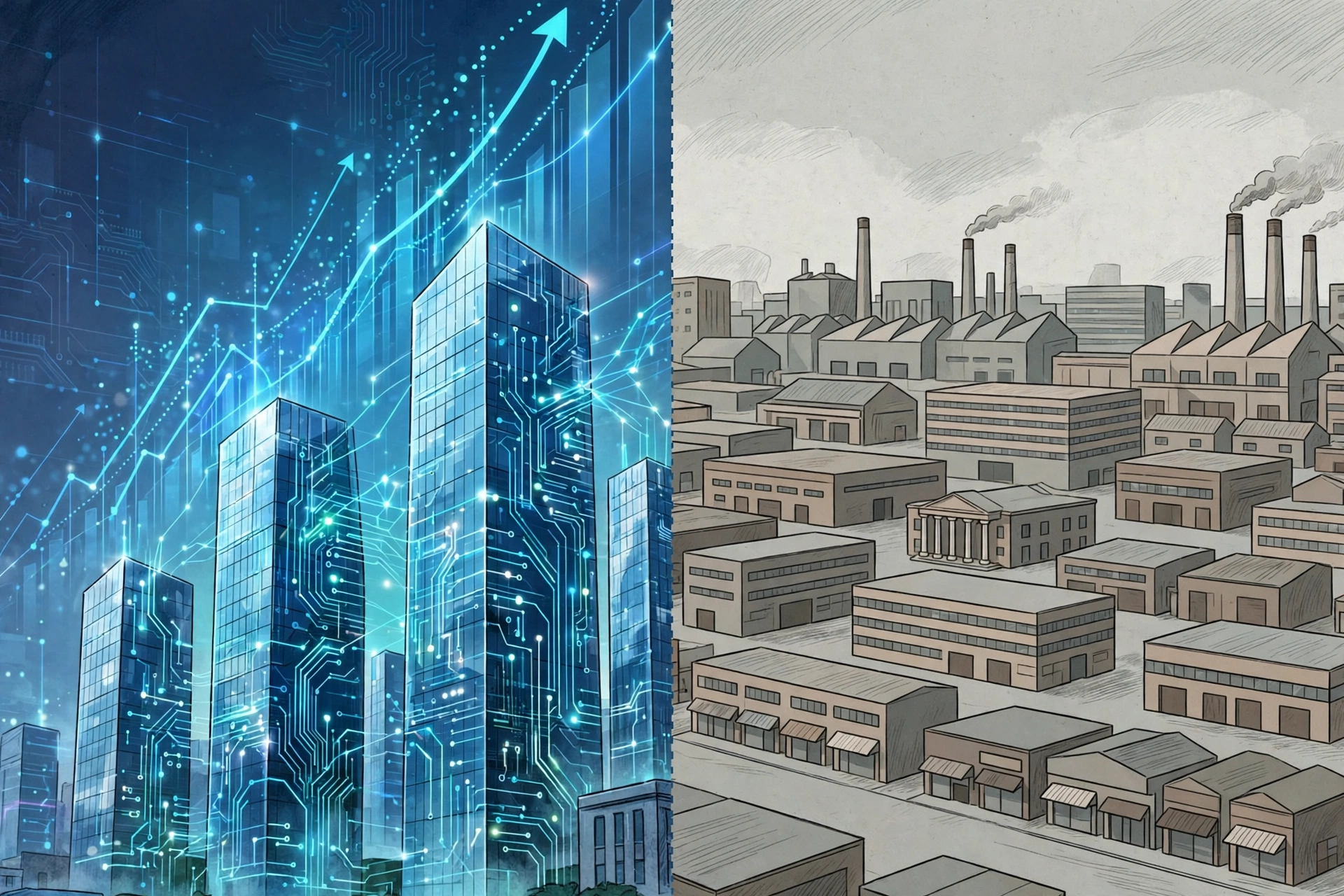
The Raoul Pal AI economy collapse prediction gives the world as we know it about four years. That is the warning from investor and Real Vision co-founder Raoul Pal, who told his 1.5 million followers on X the next four years will feel very different from anything we have lived through.
The Raoul Pal AI economy collapse prediction is not a stock market crash forecast. Pal argues AI, robotics, energy and crypto will change what work, wages, trust and running a business mean, and that the change arrives around 2030. What follows is what he said, the reasoning behind it, and why skeptics say the case is thin.
Futurism covered the post on October 31, 2026. It came with a clip from his When Shift Happens podcast and a link to buy his book, The Everything Code.
The Short Version
- Who: Raoul Pal, ex-Goldman Sachs strategist and Real Vision co-founder.
- The prediction: The Raoul Pal AI economy collapse prediction says AI, robotics, energy and crypto will advance so fast in four years that the old economy stops working as it does now.
- His name for it: The Economic Singularity, around 2030, when machines take over most work and old measures of value stop making sense.
- What it is not: A crash forecast. Pal says AI takes over the economy rather than a bubble bursting.
- Why skeptics push back: wage stagnation and inflation are old, and past crises changed life without ending the system.
- How to read it: One investor’s prediction, not a fact. Track the signals below.
What the Raoul Pal AI economy collapse prediction actually says
“Your wages haven’t kept up with the cost of living for years now,” he wrote on X. “Governments have to keep debasing the currency to fund everything, and it’s eating into your pay every single year. That part isn’t new.”
“What is new,” Pal continued, “is that we have maybe four years before the world as we know it stops working the way it does now. The exponential technologies… AI, robotics, energy, crypto… are moving so fast that the systems built for the old world can’t keep up.” He treats the four as one wave, and the Raoul Pal AI economy collapse prediction rests on that wave.
Two consequences follow. First, trust breaks down: eventually, he argues, the average person “can’t trust what you see or hear anymore.” Second, business changes shape: “Even the idea of running a business stops meaning what it means today.” Pal adds, “Nobody knows yet what it becomes.”
The Raoul Pal AI economy collapse timeline: four years to 2030
Pal has argued this before, but the clock is new. In his October 30, 2026 essay “The Price of Being Human,” he put the turning point “somewhere around 2030,” when machines take over most work and growth hits “a speed we’ve never seen.”
He also points to an early signal: AI agents multiplying. Pal said AI agents now outnumber humans on the internet, reached in only about 10 months. That figure comes from Pal himself, with no independent count cited, and the Raoul Pal AI economy collapse prediction leans on claims like this one.
The reasoning behind the warning
Pal’s deeper argument is about what becomes cheap. For all of human history, he writes, the scarce thing was knowing stuff, and a doctor, lawyer or tutor sells years of it. That is ending, he claims: intelligence will be like water, on tap, for basically nothing.
That breaks the measuring tools. GDP, wages and valuations were built for a world where humans produce and intelligence is expensive. Point them at an economy doubling in a year, he argues, and they stop telling us anything useful. The Raoul Pal AI economy collapse prediction is, at its core, a claim about measurement failing when intelligence gets cheap.
The Raoul Pal AI economy collapse prediction is not all bleak. He argues something human keeps its value because machines cannot fake it, an idea from David Mattin: the Creature Residual, value only one human can make for another. His evidence: Chess.com grew from 100 million members at the end of 2022 to more than 250 million in February 2026. He extends the same logic to trust: World’s iris-scan credential, used over 450 million times by his count, shows proving a human was involved is becoming valuable.

Why the Raoul Pal AI economy collapse prediction draws pushback
The Raoul Pal AI economy collapse prediction starts from an old observation with a new deadline attached. Futurism notes persistent inflation is not new, and Pal is far from the first to observe it. Economist Richard Wolff said the same in 2022, calling inflation a longstanding feature of capitalism, not a sign of end times.
Conditions changed drastically between 2004 and 2008, and again between 2016 and 2020. Both hit working people hard, yet the structures of capitalism survived. A world that feels unrecognizable in four years is not a system that has stopped working.
Then there is who benefits. Futurism calls the X post nakedly self-promotional: a clip of Pal’s podcast and a link to buy The Everything Code. A dramatic deadline helps sell a thesis, so read the prediction as a pitch as well as a forecast. Forbes contributor Joe McKendrick, on October 31, 2026, framed AI instead as a force that displaces and creates jobs.

Claimed, confirmed, and still unknown
The Raoul Pal AI economy collapse prediction starts from a confirmed post and a real book thesis, but what happens next is a forecast, and the sharpest claims rest on Pal’s word alone.
What to Watch Next
Judge it by Pal’s own signals. If AI agents keep multiplying and doing paid work at scale, his timeline gains weight. If wages keep trailing living costs while AI tools spread, his setup looks stronger. Those are the tests the Raoul Pal AI economy collapse prediction has to pass.
Watch the other side. If data center spending keeps rising without matching returns, the bubble reading becomes urgent. If displacement stays gradual and new roles keep appearing, the Forbes adaptation reading wins the near term. And if the Raoul Pal AI economy collapse prediction misses its own markers, the agent count and the 2030 date, mark it wrong.

Quick Answers
What is the Raoul Pal AI economy collapse prediction?
Pal’s forecast: AI, robotics, energy and crypto advance so fast in four years that the old economy stops working the way it does now. He calls the turning point the Economic Singularity, around 2030. The Raoul Pal AI economy collapse prediction is a forecast, not a confirmed event.
When does Raoul Pal say the Economic Singularity arrives?
Around 2030, per his October 30, 2026 essay and his X post that week, which speaks of maybe four years before the world stops working as it does now. Treat 2030 as his forecast.
Is Raoul Pal predicting an AI stock market crash?
No. It differs from the bubble warnings of Harris Kupperman and Michael Roberts. Pal argues AI will take over the economy, not crash AI stocks.
What do critics say about Pal’s prediction?
Futurism argues his evidence is thin: inflation and wage stagnation are old problems, and past crises changed life without ending the system. Critics also note the post promotes his podcast and book.
The Takeaway
Raoul Pal has made a bold, dated prediction: four years to an Economic Singularity around 2030, when machines take most work and the old economy stops working. The post is real, the quotes are on the record, and the logic is clear. But the evidence behind the Raoul Pal AI economy collapse prediction is thin, and history argues against the deadline.
Read it as a scenario to track, not a verdict. Watch agents, wages, trust, and data center returns. If Pal’s signals strengthen, his timeline deserves more weight. If they fade, set it aside. The Raoul Pal AI economy collapse prediction is a forecast to test against events, and events will have the last word.
Sources
- Futurism, “Investor Says We’re Rapidly Approaching the Point At Which Economic Systems Collapse Under the Weight of AI,” Oct 31, 2026. futurism.com
- Raoul Pal, “The Price of Being Human,” Substack, Oct 30, 2026. raoulpal.substack.com
- Joe McKendrick, “The Case For Optimism As AI Transforms Our Economy,” Forbes, Oct 31, 2026.
- PJFP, “Raoul Pal: Why He Says Crypto Investors Have Four Years Left to Get Rich,” Oct 15, 2026.