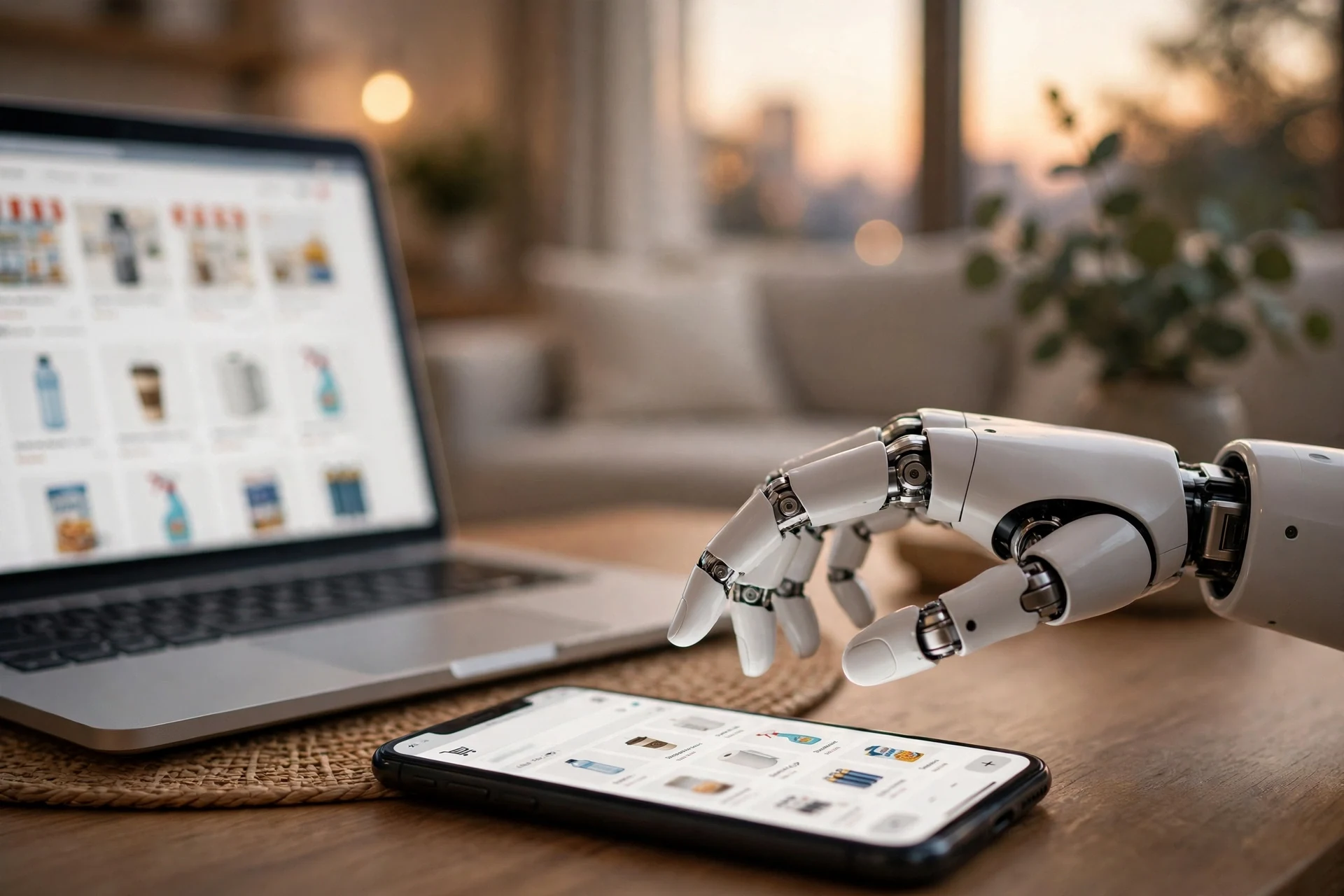
Shopping Bots Amazon Blocks: The AI Agents Rewriting Online Shopping
Meta’s Muse can shop for you, OpenAI’s Dots can too, and Walmart just opened the door. Amazon said no.
The shopping bots Amazon blocks are already at the door, and Amazon has decided most of them are not coming in. Amazon started turning away Meta’s Muse on September 20, 2026, and has since shut out agents from OpenAI, Google, Anthropic and Perplexity. The Wall Street Journal reported the standoff in Heard on the Street on October 16, with a follow-up on November 1.
The agents are simple to describe. You tell one what you want, it searches, compares prices, and completes the purchase with your approval. Meta’s Muse, launched in September for the United States and Canada, passed 10 million downloads, per Sensor Tower, cited by AFP. OpenAI launched its always-on agents, called Dots, in October. Anthropic previewed Claude Duet on October 21, and Google runs a Universal Cart in Search with AI Mode.
The Short Version
- What happened: the shopping bots Amazon blocks include Meta’s Muse, shut out on September 20, 2026, plus agents from OpenAI, Google, Anthropic and Perplexity.
- The split: Walmart, QVC and HSN welcome the shopping bots Amazon blocks; Target admits four named agents; Kohl’s and Tapestry restrict purchases.
- The money: Amazon booked $68.6 billion in ad revenue in 2025, about twice the $34.4 billion operating income of its stores, per Business Model Analyst.
- The shopper: only about 4% of consumers would let an agent complete a purchase alone, per a BCG survey cited by ForgeMesh.
- The catch: no major agent buys without your approval, and returns go through the merchant.
Shopping Bots Amazon Blocks: How the Standoff Started
The shopping bots Amazon blocks got to the door fast. Meta launched Muse on September 8, 2026, and by September 20 Amazon showed Muse users a pop-up saying the agent was unauthorized and violated Amazon’s Conditions of Use. Amazon told GeekWire that Meta never warned it Muse would shop the store, that the agent does not identify itself, and that it may store customer credentials. Meta says Muse never sees passwords or card numbers, and Muse pays with a single-use card per transaction after asking permission.
Amazon had already fought this battle in court. In November 2025 it sued Perplexity, arguing that the startup’s Comet browser agent entered customer accounts without permission. A district judge granted a preliminary injunction in March 2026, but on August 4 the Ninth Circuit vacated it, finding that the shopper, not the tool’s maker, accessed the site when the agent acted on the shopper’s instructions. The Journal’s October survey found the rest of retail split over the shopping bots Amazon blocks: QVC and HSN let agents buy, Target admits four named agents, and Kohl’s and Tapestry restrict purchases.
The Ad Money Behind the Shopping Bots Amazon Block
The shopping bots Amazon blocks never scroll past a sponsored listing. The security argument is real, and it is not the whole story. Business Model Analyst put the numbers side by side: Amazon booked $68.6 billion in ad revenue in 2025, while its store segments reported about $34.4 billion of operating income. The ad line is roughly twice the profit of the business it sits inside.
The ratio looks very different where agents are welcome. Walmart reported nearly $6.4 billion in global ad revenue against $29.8 billion of operating income in its latest fiscal year. Target reported $915 million against $5.1 billion. The gap is about tenfold, and the policies line up with it. Amazon is not against agents at all: it renamed Rufus as Alexa for Shopping in May 2026, more than 350 million customers used it in the prior twelve months, and its Buy for Me feature shops other brands’ sites while identifying itself and letting brands opt out. The policy is no agents that do not carry Amazon’s ads.

Shopping Bots Amazon vs Walmart: Two Playbooks
Walmart’s open door is the mirror image of the shopping bots Amazon blocks. Walmart unveiled tools on October 22 that let AI agents such as Meta’s Muse shop for its customers. Agent Profiles, launching within a month, let customers register each assistant separately, so agent purchases appear apart from their own. Customers can require approval for every purchase or set a spending limit, such as $50, $100 or $200. The limits are in US dollars; the feature is US-only, so no European pricing applies.
Walmart’s reasoning is commercial. Its United States chief, David Guggina, said AI tools were bringing in new customers at strong conversion rates, and its own assistant, Sparky, already sits inside ChatGPT, so Walmart keeps the checkout even when the conversation starts elsewhere. Shopify made the same calculation for millions of merchants: on September 21 it said Muse can check out with Shop Pay across all Shopify stores.
The shopper side is slower than the headlines. A BCG survey of 50 of the top 300 global retailers and 100 top brands, cited by ForgeMesh, found 42% make product data discoverable to any agent, 32% let in only chosen agents, 6% block agents outright, and 20% have not decided. Agent referrals were under 1% of retail site visits in late 2025. BrightEdge estimates agent purchases are growing 43% a month, yet only about 3% of the e-commerce companies it tracks let agents complete a transaction.

Confirmed, Reported and Still Unknown
- Confirmed: the shopping bots Amazon blocks include Muse, shut out on September 20, 2026, plus agents from OpenAI, Google, Anthropic and Perplexity. Walmart unveiled Agent Profiles on October 22. The Ninth Circuit vacated the Perplexity injunction on August 4, 2026.
- Reported: the Wall Street Journal’s October 16 column and November 1 story describe the retailer split. BrightEdge estimates agent purchases are growing 43% a month. BCG’s figures come via ForgeMesh.
- Still unknown: Meta has not disclosed the transaction fee it plans to charge merchants. Amazon has not said whether it will admit outside agents under any terms. No agent has published verified purchase volumes, and QVC cannot confirm any agent purchase yet.
What to Watch Next
Whether the shopping bots Amazon blocks ever get a paid way in is the question to watch. The shopping bots Amazon blocks are, for now, a North American story: as of October 16, 2026, none of the four assistants was documented to take payments outside North America, so readers in Bangladesh and South Asia have no agent shopping option in this story yet. Amazon’s next earnings report will show whether advertising keeps outpacing retail sales. Walmart’s Agent Profiles launch, due within a month, will show whether shoppers register agents. Fed governor Christopher Waller said in a September 29 speech that authentication means proving an agent may pay on the buyer’s behalf, and nobody has a settled answer yet.

Quick Answers
Will the shopping bots Amazon blocks today ever get back in?
Possibly, but only on Amazon’s terms. If the shopping bots Amazon blocks are admitted under a deal where the agent pays Amazon or carries its sponsored placements, the ad-money reading is confirmed. If Amazon lets outside agents in on neutral terms, the security explanation was the real one. Nothing so far points to neutral admission.
Can Meta’s Muse shop on Amazon?
No. Since September 20, 2026, Amazon has shown Muse users a message that the agent is not authorized under its Conditions of Use. Muse works with Walmart, Best Buy, Gap, Sephora and Shopify stores instead.
Do shopping agents buy without asking me?
No, not the major ones, including the shopping bots Amazon blocks. Each one asks for approval before paying: Google asks for the total, ChatGPT asks for confirmation in chat, Muse asks for approval in the conversation, and Amazon’s Buy for Me works within a target price you set. You can also set spending limits, such as Walmart’s $50, $100 or $200 caps.
The Takeaway
Amazon did not block the shopping bots because they do not work. The shopping bots Amazon blocks will keep knocking, because they work without looking at the shelf, and the shelf is where Amazon makes its money. Walmart opened the door to the shopping bots Amazon blocks because it has more to gain from the comparison than to lose. For now, let an agent research and shortlist, approve every purchase yourself, and keep the receipt with the merchant. The checkout still belongs to whoever you trust with your card.
Sources / Attribution
- The Wall Street Journal, Isabella Simonetti and Suzanne Vranica, “The Shopping Bots Are Coming for Amazon,” November 1, 2026. Paywalled; not read directly. Story details verified through the alternate sources below.
- TradingView / Dow Jones Newswires, summary listing of the WSJ story, November 1, 2026. tradingview.com
- Iceclog, “Retailers Divided Over AI Shopping Agents as Agentic Commerce Expands,” October 23, 2026. iceclog.com
- Business Model Analyst, “Amazon Won’t Let Your AI Agent Shop. Its Ad Business Explains Why,” October 17, 2026. businessmodelanalyst.com
- AFP via TechXplore, “Walmart welcomes AI agents as Anthropic launches its own,” October 22, 2026. techxplore.com
- ForgeMesh, “AI Shopping Agents: Who Blocks, Who Allows,” October 26, 2026. forgemesh.io
- Morningstar / Dow Jones, “Amazon Offers Shopping AI Tool to Other Retailers,” May 27, 2026. morningstar.com