A 78-year-old professor, a six-wheeled food courier and a sidewalk in Center City. What happened next says a lot about who owns public space.
Philadelphia delivery robots became national news on October 14, 2026, when a 78-year-old retired professor stood in front of one on Filbert Street and refused to move. Police handcuffed Carolyn Marvin, a former University of Pennsylvania communications professor, and cited her for disorderly conduct. The arrest turned a sidewalk standoff into a public argument about jobs, public space and the legal rights of machines.
Marvin was walking home from a flu shot appointment, a jar of enchilada sauce in one hand and biryani takeout in the other, when she met the Avride robot near Reading Terminal Market. She did what she had done for months: stepped in front of it and stayed there. A crowd gathered. Someone called the police.
Police said officers had answered a report of criminal mischief involving a delivery robot. Officers found Marvin refusing to let the machine pass, gave her repeated orders to move, and arrested her when she refused. She told CNN she had never expected to be arrested. “I wasn’t impeding any persons. I was impeding a machine,” she said.
The Short Version
- Carolyn Marvin, 78, a retired University of Pennsylvania communications professor, was arrested on October 14, 2026, after blocking an Uber Eats delivery robot on Filbert Street near Reading Terminal Market, and cited for disorderly conduct after refusing orders to move.
- She had been blocking Philadelphia delivery robots for months to protest job losses, sidewalk hazards and camera privacy.
- Pennsylvania law classifies the robots as pedestrians, but requires them to yield to human pedestrians and cyclists.
- Uber Eats launched the Avride fleet in Philadelphia in March 2026, and Avride expanded it with Grubhub and Wonder on October 21.
Philadelphia Delivery Robots: What Happened on Filbert Street
October 14 was not the first time Marvin put herself in front of a robot. Since the wheeled food carriers appeared on Philadelphia sidewalks, blocking Philadelphia delivery robots had become a habit. She would stand in front of one when she met it, delaying it for a few minutes. The delay was usually 10 or 15 minutes at most, she told CNN.
She had done it before, including an incident on Broad Street in September that circulated on social media. Stopping in front of the machines started conversations with passersby, most of them supportive or curious. On October 14 the crowd was larger than usual, and some were critical. Marvin suspects a member of the crowd called the police.
Officers handcuffed her, put her in the back of a squad car and gave her the citation. One friend later put it this way, she said: “Well, you got a disorderly conduct charge for impeding capitalism.” Asked if she plans to keep blocking robots, she was direct: “Oh yeah.” This time she will watch for the police.
Why She Stands in the Way
Marvin views her actions as a symbolic protest against three problems she sees in Philadelphia delivery robots. The first is the displacement of low-income delivery workers. “I know they’re taking the jobs of human delivery workers,” she told WPVI Action News, “and so, I have been protesting them whenever I saw them by standing in front of them.”
The second concern is the physical hazard Philadelphia delivery robots pose on sidewalks shared with pedestrians, wheelchair users and children. The third is privacy: the robots navigate with embedded cameras. She frames the protest as a First Amendment right to demonstrate in the same public space the robots occupy.
This is not her first protest. She has demonstrated for civil rights, abortion rights and Black Lives Matter, and against the Gulf and Vietnam wars. “There’s a way in which we’ve surrendered the streets to cars long ago, and I don’t think we should surrender the sidewalks to machines,” she said. The robots, she argued, make the tech takeover visible in a way algorithms and AI systems do not.

Philadelphia Delivery Robots and the Law on the Sidewalk
The arrest exposed a strange piece of Pennsylvania law. In 2020, the state legislature passed a law that classifies autonomous delivery robots, what the law calls “personal delivery devices”, as pedestrians, not vehicles. Democrats, labor unions and accessibility advocates largely opposed it. Republicans presented it as an exciting technological advance.
The law gives the machines real standing on the sidewalk. A vehicle must yield to a delivery robot on a crosswalk, just as it would to a person, according to Philadelphia personal injury attorney John Mattiacci. At the same time, humans sit at the top of the hierarchy in theory. “Personal delivery devices must yield to other pedestrians and pedalcyclists in a pedestrian area,” Mattiacci said.
That is the contradiction at the heart of the Philadelphia delivery robots story. The law says the robot must yield to Marvin, yet the police ordered Marvin to move for the robot. Her charge does not settle whether her protest was constitutionally protected. The penalties are modest: Inc. reported disorderly conduct fines average $100 (about 86 euros) per ticket, and the Inquirer reported operator fines of $25 to $1,000 (about 22 to 860 euros). Euro figures are approximate conversions.
The Machines Themselves
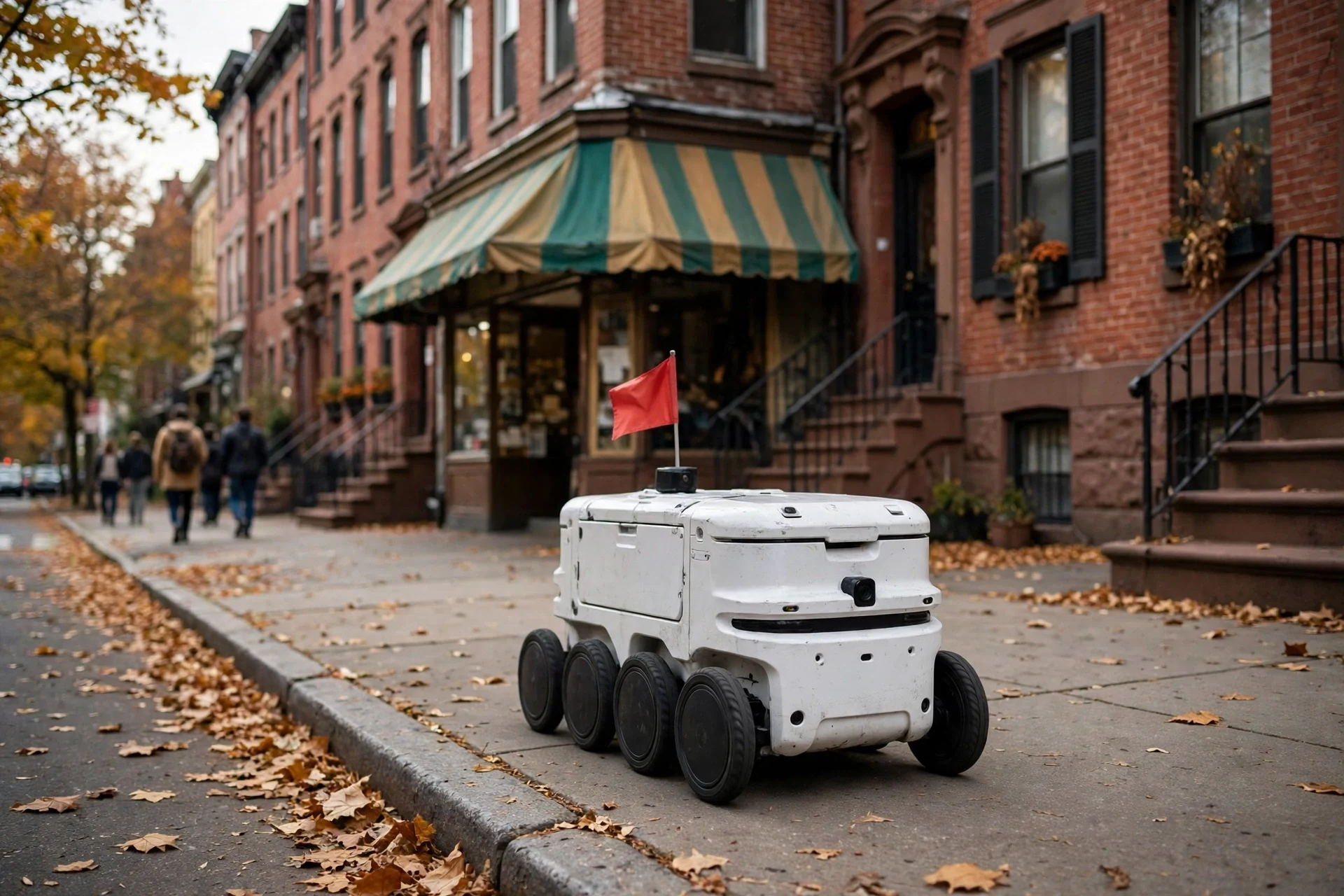
The robots at the center of the Philadelphia delivery robots debate are built by Avride, an Austin-based autonomous driving company. They stand just under three feet tall, travel at up to five miles per hour and carry up to 55 pounds of food. Cameras, sensors and lidar guide them, and they can run for up to 12 hours on a charge, according to the Philadelphia Inquirer.
Uber Eats launched the fleet in March 2026, making Philadelphia the fourth city where meals can be delivered by robot, with service from 10 a.m. to 10 p.m. and an opt-out for customers. On October 21, Avride expanded with Grubhub and Wonder, adding 25 Wonder restaurant concepts at Rittenhouse and nine more Grubhub restaurants. The machines were not universally welcomed: videos show people sitting on them, kicking them or vandalizing them. Uber says the robots complement human couriers, and no reporting so far establishes that any delivery jobs have been lost.

Confirmed, Reported and Unknown
- Confirmed: the October 14 arrest, the disorderly conduct citation, the March 2026 launch and the 2020 law.
- Reported: the September Broad Street incident and the October 21 expansion.
- Unknown: whether any jobs have been lost, how the citation will be resolved, and how many robots now operate in Philadelphia.
Philadelphia Delivery Robots: What Comes Next
Marvin plans to keep standing in front of Philadelphia delivery robots. She has said she will do it again, and she has also said she will watch for the police. Her citation still has to run its course, and no court has yet ruled on whether her protest is protected speech. That question matters beyond one woman and one robot, because other cities are watching Philadelphia.
The fleet is not shrinking. Avride’s October 21 expansion put robot delivery in front of more restaurants and more customers, and the company has shown no sign of slowing down. Until a court or a new law settles who the sidewalk belongs to, the same standoff will keep happening.
Quick Answers
What are Philadelphia delivery robots?
They are small six-wheeled Avride robots that carry food orders along city sidewalks for Uber Eats, Grubhub and Wonder. They stand just under three feet tall, travel at up to five miles per hour and carry up to 55 pounds.
Why was Carolyn Marvin arrested for blocking Philadelphia delivery robots?
On October 14, 2026, she stood in front of an Uber Eats robot on Filbert Street and refused repeated police orders to move. Officers arrested her and issued a disorderly conduct citation.
Do Philadelphia delivery robots have to yield to pedestrians?
Yes. Pennsylvania’s 2020 law classifies the robots as pedestrians, but it requires them to yield to human pedestrians and cyclists in pedestrian areas.
The Takeaway
A 78-year-old professor was arrested for standing in front of a machine that kept its legal status as a pedestrian. That is the strange core of the Philadelphia delivery robots story. The law says the robot must yield to people, yet the person was the one ordered to move. Marvin’s protest will continue, and the question of who owns the sidewalk is still open.
Sources / Attribution
- CNN, Zoe Sottile, “This retired professor was arrested for blocking a delivery robot. She says she’ll do it again,” October 31, 2026, read via KION Central Coast syndication of the full CNN Wire piece. CNN.com itself was not opened; the article was read in full through the KION syndication.
- Inc., “A Woman Was Arrested for Blocking a Delivery Robot. Her Reason for Doing It Taps Into a Deep Fear,” October 16, 2026.
- The Hook, “Woman Arrested for Blocking Uber Eats Robot,” October 16, 2026.
- CyberGuy, “Woman arrested after standoff with Uber Eats robot,” October 2026.
- Philly Talks, “Delivery Robots Move From Jersey City Sidewalks to Philadelphia Streets,” October 2026.
- Gadget Review, “Philadelphia Woman Arrested for Blocking Uber Eats Delivery Robot,” October 2026, citing the Philadelphia Inquirer.
- iTechPost, “Philadelphia Woman Carolyn Marvin Arrested for Blocking an Autonomous Delivery Robot,” October 19, 2026.
- Times Now World, “Philadelphia Professor Faces Charges After Repeatedly Blocking Delivery Robots,” October 31, 2026.
- Understandably, “Get out of the way,” October 29, 2026.