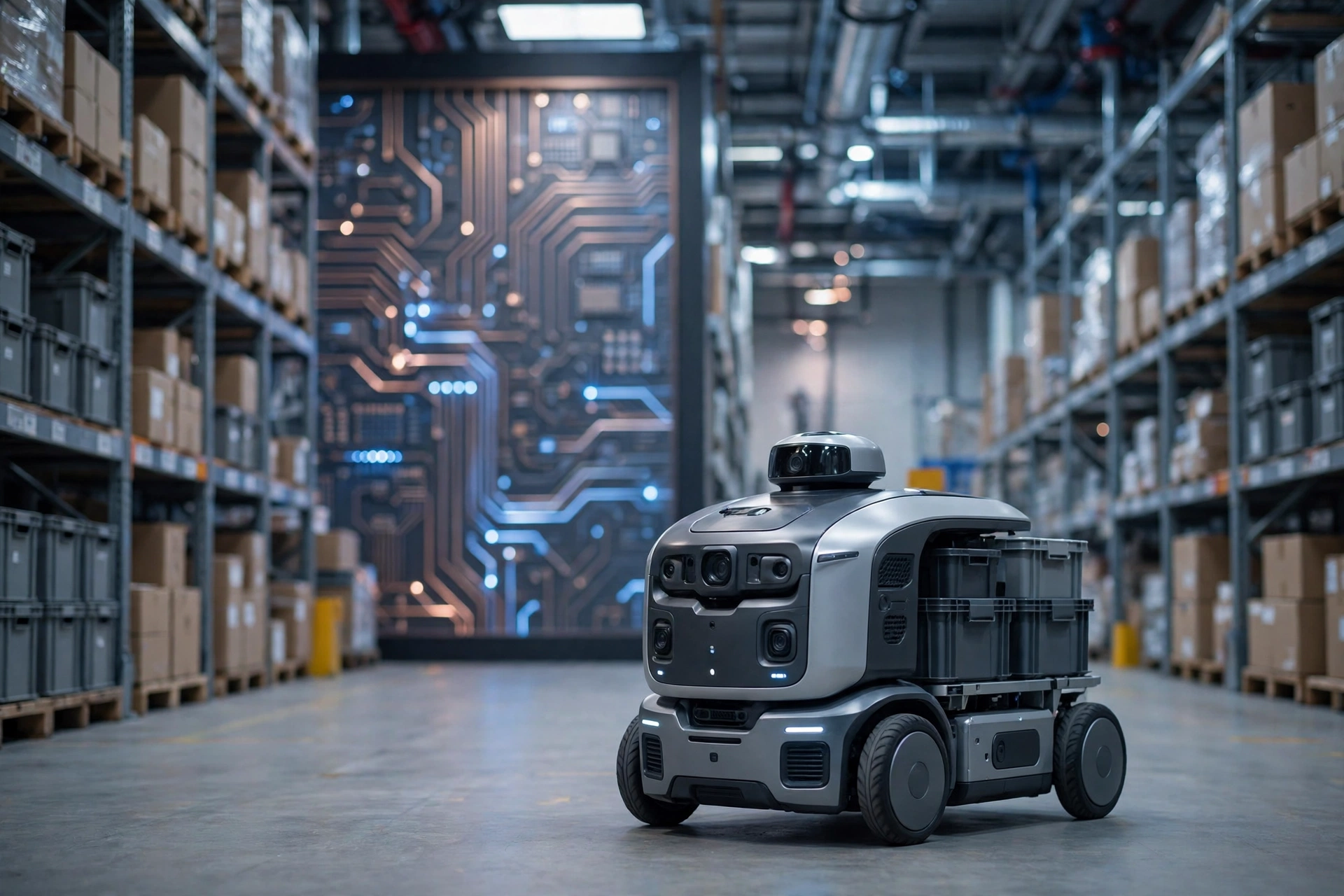
Original illustration of an autonomous mobile robot in a warehouse.
BlackBerry QNX robots are the next act for QNX, the chief executive says, citing a record backlog and an Nvidia partnership. The evidence supports a real pivot. It does not yet prove a robotics business at scale.
BlackBerry QNX robots are now the center of the company’s growth story. Chief Executive John Giamatteo told CNBC’s Mad Money on Monday, October 26, 2026, that artificial intelligence powered robots are a major growth opportunity beyond cars, with robotics already among the fastest-growing businesses inside the QNX software division.
The pitch is a long way from the BlackBerry of the phone era. QNX, the company’s real-time operating system for safety-critical systems, is embedded in more than 275 million vehicles worldwide, according to BlackBerry, and the BlackBerry QNX robots push aims to take the same software into machines that sense and act in the real world, a field it calls physical AI.
Giamatteo’s case rests on two numbers and one partnership. The numbers are a record royalty backlog above $1.2 billion (USD) and that 275 million vehicle base. The partnership is an April 2026 integration of QNX software with Nvidia’s safety platform for robots and industrial machines.
The Short Version
- Giamatteo told CNBC’s Mad Money on October 26 that AI-powered robots are a major growth opportunity for BlackBerry, with robotics among the fastest-growing parts of QNX, the division behind BlackBerry QNX robots.
- QNX is embedded in more than 275 million vehicles, a cumulative company figure, and BlackBerry wants the same safety-critical software in robots, medical devices and industrial machines.
- BlackBerry QNX robots get their strongest backing from a record QNX royalty backlog above $1.2 billion (USD), announced October 20, 2026. The backlog is estimated future royalties, not revenue already earned.
- Nvidia’s Halos Safety Stack runs with QNX OS for Safety 8.0 on IGX Thor, under an April 2026 integration for mobile robots, humanoids and surgical robots.
- What is not disclosed: how much of the backlog comes from robotics, deployment scale, or timing for humanoid robots, which Giamatteo has called early stage.
BlackBerry QNX robots: what Giamatteo told Cramer
Giamatteo described a company whose products are no longer things you hold. “The products we sell today can’t be held in the palm of your hand; they are pervasive around you,” he said, naming cars, robots, governments, medical instruments and supply chains. He called that reach the driver of all of the company’s growth.
He named three drivers for the QNX business. The first is the auto industry’s move to high-performance compute architectures, which puts more software into each vehicle. The second is Alloy Kore, which combines the QNX operating system with middleware to widen the addressable market.
The third driver is emerging growth in physical AI, the field where BlackBerry QNX robots must prove themselves, and the company’s term for machines that sense and act in the real world.
That third driver is where BlackBerry QNX robots enter the story. Giamatteo called robotics one of the fastest-growing businesses inside the QNX portfolio, repeating a description from an earlier CNBC conversation. The claim describes relative growth inside one division, not a disclosed revenue figure, and BlackBerry has not said how much of its backlog comes from robotics.
The Mad Money appearance repeated a theme from all year. Earlier, he pointed to warehouse robots, autonomous forklifts and medical equipment as the nearer-term opportunity, not home humanoids. He put humanoid robotics “probably in the first inning.”
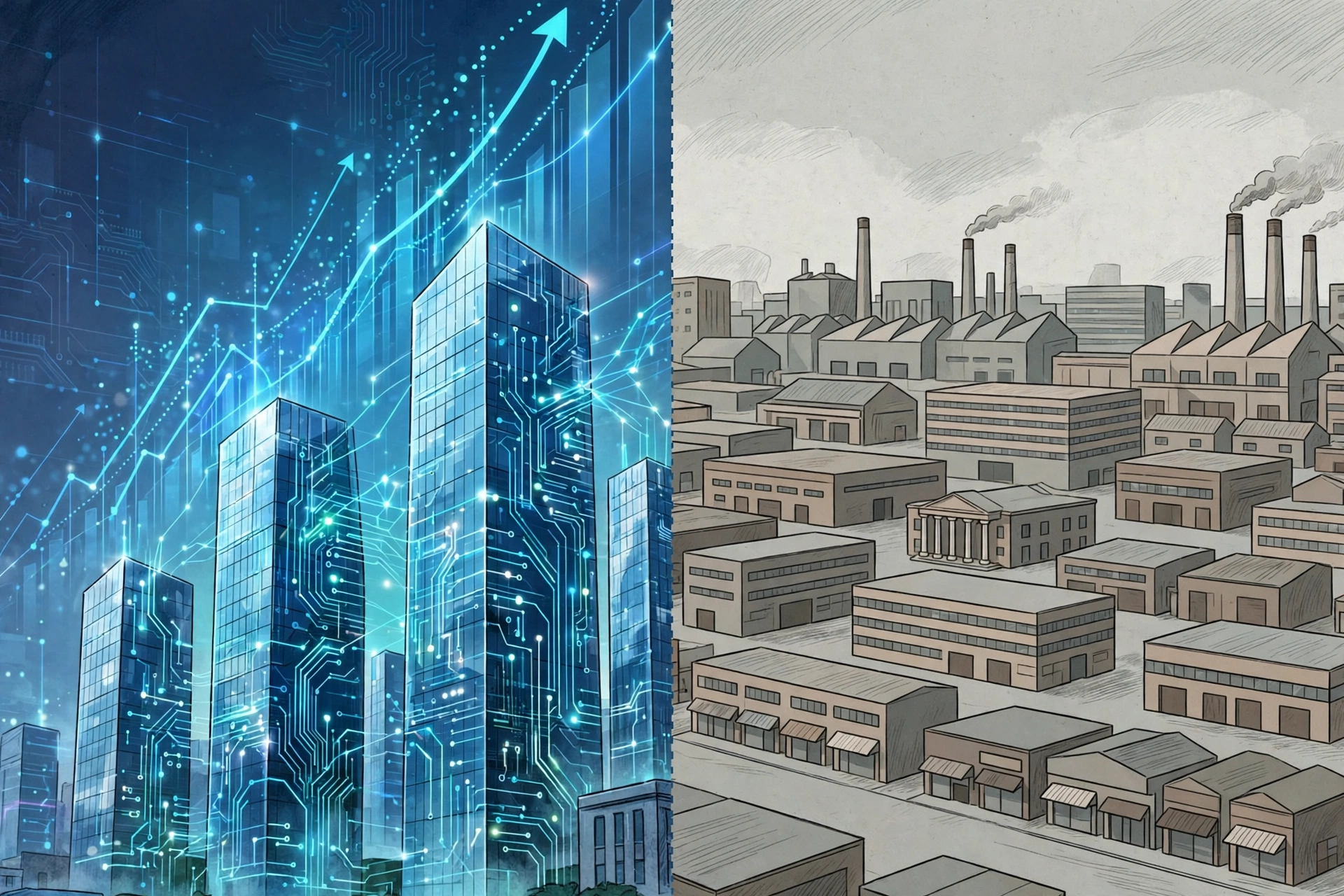
BlackBerry QNX robots and the $1.2 billion backlog
The backlog gives BlackBerry QNX robots their hardest evidence. On October 20, 2026, BlackBerry announced a record QNX royalty backlog above $1.2 billion (USD). The figure rose by more than $250 million (USD), or more than 26%, from about $950 million (USD) at the end of fiscal year 2026.
BlackBerry credited two drivers: adoption of QNX Software Development Platform 8.0, which supports the centralized compute architectures automakers are moving toward, and the first design win for Alloy Kore, QNX’s foundational automotive operating system, valued at more than $100 million (USD) in estimated future royalties, the largest design win in QNX history.
General Embedded Markets and physical AI systems also contributed, BlackBerry said, through design wins across robotics, industrial automation and medical devices. That is the closest the announcement comes to sizing the BlackBerry QNX robots opportunity. It names sectors and confirms momentum, but gives no robotics revenue, backlog share or customer names.
Read the backlog definition before treating it as sales. BlackBerry defines QNX royalty backlog as estimated future revenue from variable forecasted royalties, based on royalty rates and volume projections over each design’s lifetime. The company warns it may not indicate actual future revenue, because recognized revenue depends on production volumes and contracts surviving unchanged.

BlackBerry QNX robots: where the Nvidia deal fits
The Nvidia relationship behind BlackBerry QNX robots predates the October interview. In April 2026, at Hannover Messe, QNX announced an expanded collaboration with Nvidia that integrates QNX OS for Safety 8.0 with the Nvidia IGX Thor platform and the Halos Safety Stack. The combination targets regulated, AI-enabled systems, including autonomous mobile robots, humanoids, surgical robotics, medical imaging and industrial automation platforms.
For BlackBerry QNX robots, the engineering idea is mixed criticality on one platform. QNX supplies a deterministic, microkernel-based real-time operating system for safety-critical control, while Nvidia’s accelerated compute handles AI work such as perception, planning and decision-making. Developers can consolidate real-time controls and safety concepts on the QNX foundation instead of wiring two separate systems together, one for safety and one for AI.
The Nvidia work does two jobs for BlackBerry QNX robots. It gives QNX a named silicon partner in the markets Giamatteo cites, and it transfers an automotive safety argument into factories and hospitals, where regulators also demand certified behavior. QNX president John Wall put it this way in April: “As robotics, medical, and industrial systems become more autonomous and software defined, safety and determinism cannot be afterthoughts.”
What the April announcement does not show is scale. Neither company disclosed how many robots use the combined platform, which customers ship it, or what royalty value it carries. Giamatteo cited Nvidia’s adoption of QNX for robotics on Mad Money as a growth driver, but adoption here means a platform integration for developers, not a count of machines in service, so treat the BlackBerry QNX robots opportunity as an open door, not a deployed fleet.
The Bigger Picture
The robot story continues a pivot that began a decade ago. BlackBerry stopped developing its own phones in 2016, and the former phone maker now sells embedded software and secure communications from Waterloo, Ontario. QNX has powered safety-critical applications for nearly half a century, according to the company, and its technology now underpins vehicles plus industrial controls, robotics, medical devices, transport, rail and defense systems.
What QNX actually does is narrower than the word “AI” suggests. It is a real-time operating system, hypervisor, middleware and toolset built so one component’s failure does not take down a safety function. In cars that means braking, driver assistance and digital cockpit software running with predictable timing, and in BlackBerry QNX robots it means motion control and safety stops stay deterministic while AI perception runs alongside them.
Giamatteo has drawn a deliberate line on AI inside that code. In earlier CNBC remarks, he said BlackBerry is careful about how much AI goes into its products’ code, because failure is not an option in these machines. “Blue screening in a robotaxi is not an option,” he said.
The company uses AI heavily behind the scenes, to test products and speed integration work, while keeping it largely out of the safety-critical code itself, according to coverage of those remarks.
The market has noticed the pivot, with limits. BlackBerry shares had risen about 142% in 2026 at the time of the interview, according to market coverage, and the fiscal second quarter brought QNX revenue of about $80 million (USD), up 27% from a year earlier, according to coverage of the company’s results.
Neither figure proves the robotics case alone. The share price reflects the whole company, and QNX revenue covers all of QNX, not robots alone.

Confirmed vs Reported vs Unknown
The record below separates what is established from what remains characterization or unknown. CEO characterizations signal strategy. They are not audited segment results.
FAQ
Are BlackBerry QNX robots already working in warehouses today?
No deployment at scale has been disclosed. The Nvidia integration announced in April 2026 is a developer platform for autonomous mobile robots and other machines, and BlackBerry has not named warehouse customers or unit counts. The BlackBerry QNX robots story today is a platform and pipeline story, not a fleet census.
What is QNX?
QNX is BlackBerry’s real-time operating system and embedded software division, the foundation of BlackBerry QNX robots, built for safety-critical systems where timing must be predictable. It provides the operating system, hypervisor, middleware and development tools used in vehicles, robots, medical devices and industrial controls. QNX is headquartered in Ottawa, Canada.
What does the $1.2 billion backlog actually mean?
It is BlackBerry’s estimate of future royalty revenue from QNX design wins, based on royalty rates and projected volumes over each design’s life. It is not revenue already recognized, and BlackBerry warns it may not indicate actual future revenue if volumes or contracts change. Robotics contributed to its growth, but its share was not disclosed.
Is BlackBerry still making phones?
No. BlackBerry stopped developing its own phones in 2016. The company now focuses on embedded software through QNX and on secure communications for enterprises and governments.
The Takeaway
BlackBerry QNX robots are a credible direction with incomplete proof. The backlog is real, defined and growing.
The Nvidia integration is real, dated and specific. The 275 million vehicle base is real and company-reported.
What is missing is the robotics split: revenue, backlog share, named deployments and timing. Until BlackBerry discloses those, the BlackBerry QNX robots story rests on characterization, not a measured segment. Watch the next quarterly results for the next hard numbers.
The bottom line for readers: BlackBerry has earned attention for the pivot. It has not yet earned a verdict on robots.
The evidence supports watching the pipeline. It does not support assuming the fleet.
Sources / Attribution
- BlackBerry and QNX, “BlackBerry’s QNX Royalty Backlog Exceeds $1.2 Billion, Increasing More Than $250 Million in Two Quarters,” ACCESS Newswire release, October 20, 2026. Read the release via Morningstar.
- CNBC, Mad Money interview with BlackBerry CEO John Giamatteo, October 26, 2026, as covered by WhatJobs, Stocktwits and Mezha. WhatJobs coverage of the interview.
- QNX and Nvidia, expanded collaboration on QNX OS for Safety 8.0 with Nvidia IGX Thor and Halos Safety Stack, Hannover Messe, April 20, 2026. Robotics and Automation News report.
- Mezha, “BlackBerry Targets Robotics and Physical AI as New Growth Markets,” October 2026. Mezha report.
- BusinessChief, coverage of earlier CNBC remarks by John Giamatteo on robotics, AI caution and humanoid timing, August 2026. BusinessChief report.