
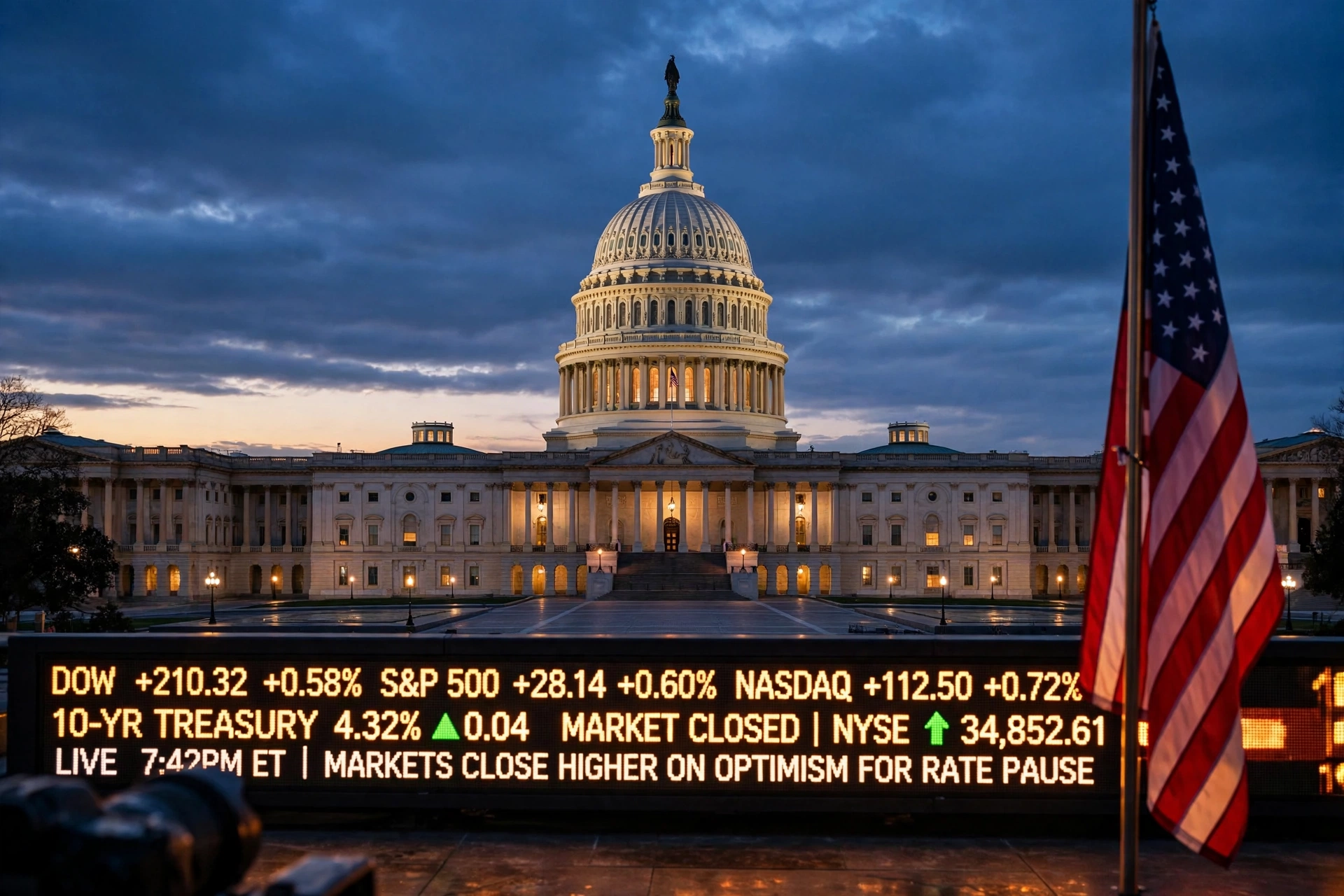
 Americans vote on November 3, and Wall Street has already placed its bets on midterm election stocks. The odds say Democrats take at least one chamber, and the market is pricing in investigations, not legislation.
Midterm election stocks are moving before a single ballot is counted. Americans vote on November 3, 2026, for all 435 seats in the House of Representatives and a third of the Senate, and Wall Street expects Democrats to win at least one of the houses of Congress. That expectation is already visible in the market: a UBS basket of stocks tied to Republicans has plunged since hitting a peak in August, badly lagging the S&P 500 Index.
The presidency is not on the ballot, which is the first thing to understand about this election. Whatever Congress emerges on November 4, Donald Trump will still be president, with veto power over any legislation he dislikes. Markets care about the midterms less for the laws that follow and more for what changes in oversight, budgets and the regulatory mood in Washington.
Since Trump returned to the White House in 2025 with full Republican control of Congress, the S&P 500 has gained about 27 percent, helped by vast capital spending on AI and strong earnings growth. Treasury yields are also substantially higher. The midterms will test whether that run can survive a Congress that starts asking harder questions about the spending.
The Short Version
- The vote: November 3, 2026, all 435 House seats and one-third of the Senate; the presidency is not on the ballot.
- The odds: prediction markets put Democrats at about 90-93 percent for the House and about 65-67 percent for the Senate; Republicans keeping both chambers is about 7.5-9.3 percent.
- The market signal: a UBS basket of Republican-tied stocks has plunged since its August peak, lagging the S&P 500 badly.
- The big theme: AI oversight tops the list, with defense, healthcare, banks and crypto all exposed.
- The limit: the presidential veto means investigations and hearings, not new laws, are the likely market mover.
- The history: post-midterm returns have usually been positive, with divided government under a Republican president historically the strongest setup.
What Midterm Election Stocks Are Pricing In
The most likely outcome, on every measure available, is divided government: Democrats take the House, Republicans hold the Senate, or Democrats take both. Prediction markets cited on October 26-27 put Democrats at about 90-93 percent to win the House and about 65-67 percent to win the Senate, with Republicans keeping both chambers at only about 7.5-9.3 percent. Decision Desk HQ was more cautious on October 18, giving Democrats 77 percent in the House and 56 percent in the Senate, and generic ballot averages show Democrats ahead by roughly 7 to 8 points.
What the market is pricing in is not a policy revolution but an oversight regime. If Democrats win both chambers, investors expect tougher oversight of AI, which could weigh on markets, plus the ability to investigate Corporate America while trying to slow deregulation. If Democrats win the House but Republicans keep the Senate, a divided Congress raises the risk of government shutdowns and debt-limit brinkmanship, and spending trade-offs on defense and healthcare subsidies could widen deficits down the line.
In a Republican sweep, the least likely outcome, investors expect the White House could pursue more tax reform or boost defense spending, worsening an already large deficit, while the risk of new AI regulation and congressional probes would be low.

How Midterm Election Stocks Split by Sector
Technology and AI infrastructure sit at the center of the election trade. Democrats are expected to push for stricter regulation and oversight of the technology, and investigations could weigh on the AI trade that has driven the stock market for the past few years. Probes could speed up efforts to require safety standards for frontier AI models, independent evaluations and incident reporting, and to hold data-center developers more accountable. Investors have banked on an optimistic outlook for AI expansion, and any doubt about its rapid growth causes sharp market moves, even as just one in three Americans approve of the fast pace of data-center construction.
But the veto limits the damage. Regardless of what happens in the midterms, Trump will still be president and is likely to veto any legislation considered unfavorable to the technology industry. That may limit risk for Nvidia and the major AI spenders like Alphabet, Meta and Microsoft. As Morgan Stanley’s Ariana Salvatore put it: “The midterms will be critical not for the immediate risk of federal policy restricting data centers but to lay the groundwork for potential legislation toward that end in 2029.”
Healthcare is the clearest winner among midterm election stocks under a Democratic showing. Hospitals may benefit if Democrats manage to walk back Medicaid cuts included in last year’s tax bill. Hospital names like Acadia Healthcare, HCA Healthcare and Tenet Healthcare have near-term upside linked to the election, according to Jefferies analysts. Insurers Centene and Oscar Health could also catch bids on hopes that Democrats will negotiate to restore enhanced Affordable Care Act subsidies that expired at the end of last year.
Defense cuts the other way for midterm election stocks. Shares of defense contractors have underperformed this year amid worries that a potential Democratic sweep would lead to tighter oversight and funding delays. Drone stocks such as AeroVironment and Kratos Defense and Security Solutions have had some of the biggest declines. If Republicans hold their ground, military spending could rise, according to JPMorgan, which points to L3Harris Technologies, Lockheed Martin and Northrop Grumman as possible beneficiaries.
Financials and crypto round out the picture. Republicans tend to favor lighter oversight of the financial sector, so a surprise sweep by the party would favor lenders such as Bank of America, Citigroup and Wells Fargo. Crypto firms, meanwhile, are likely to catch congressional heat simply based on the industry’s close ties to the Trump family. The CLARITY Act, the market-structure bill that passed the House 294-134 in July 2025, failed a Senate procedural vote 49-50 on September 15, short of the 60 votes needed.

What History Says About Midterm Election Stocks
History is kinder to post-midterm markets than the pre-election nerves suggest. Since 1930, there have been eight midterm cycles when the president’s party lost control of the House, and the S&P 500 rose for the remainder of the year five times, according to Ned Davis Research. It posted a median gain of 1.4 percent from Election Day through year-end, slightly less than the 1.9 percent posted across all post-Election Day midterm years.
Morgan Stanley’s longer view is stronger still. Historically, divided government under a Republican president has produced well above average post-midterm returns in the bank’s data: about 23 percent, versus about 12 percent across all outcomes. The logic is familiar: gridlock limits the chance of disruptive new policy, while the economy keeps running.
The caveat is that this cycle is not a normal one. Persistent inflation, elevated Treasury yields, strong AI-related investment and uneven consumer spending could have as much influence on stock performance as the balance of power in Washington. The election will not settle the debt ceiling, the AI spending debate or the future of crypto regulation. Those fights are scheduled for 2027 and beyond.

Quick Answers
Which midterm election stocks benefit if Democrats win the House?
Among midterm election stocks, hospitals look like the clearest winners, with HCA, Tenet and Acadia named by Jefferies as having near-term upside if Democrats walk back Medicaid cuts or restore enhanced Affordable Care Act subsidies. Insurers Centene and Oscar Health could also benefit. Defense and crypto face more scrutiny, while AI names face investigations rather than new laws.
Can a Democratic Congress actually regulate AI?
Not easily, and not quickly. Trump remains president with veto power, so new AI legislation is unlikely before 2029. What a Democratic House can do is investigate, hold hearings and push for safety standards and incident reporting, which can move AI stocks even without a single new law passing.
What happens to crypto after the midterms?
The CLARITY Act, the market-structure bill, passed the House 294-134 in July 2025 but failed a Senate procedural vote 49-50 on September 15, short of the 60 votes needed. Crypto firms also face congressional heat over the industry’s close ties to the Trump family. Morgan Stanley flags tougher scrutiny of custody and stablecoins under divided government.
Do midterm election stocks usually rise after the vote?
Historically, yes. The S&P 500 rose for the remainder of the year in five of the eight midterm cycles since 1930 when the president’s party lost the House, with a median gain of 1.4 percent from Election Day to year-end. Divided government under a Republican president has historically produced about 23 percent post-midterm returns, versus about 12 percent on average.
The Takeaway
Midterm election stocks are telling a story about oversight, not about legislation. Wall Street expects Democrats to win at least one chamber on November 3, and the market has already started pricing in what that means: investigations for AI, funding fights for defense, a possible reprieve for hospitals, and a longer wait for crypto rules. The presidential veto means none of it becomes law quickly, and history says the market usually rises once the uncertainty ends. But the AI trade, the data-center boom and the debt ceiling are all still unresolved, and the Congress elected on November 3 will spend the next two years deciding how hard to push on each. The vote ends the campaign. It starts the audit.
Sources: CNBC, “Midterm election stocks: defense, healthcare, crypto, AI” (blocked to text fetch; built from verified alternates named below); Advisor Perspectives, “AI Policy Fears Grip Stock, Bond Traders With Midterms Days Away” (Bloomberg News, October 30, 2026); Reuters, “Analysis: Investors gaming out Congress control for spending, AI outlook” (November 2, 2026); Liquidity Finder, “Pricing the Ballot: What the US Midterms Could Mean for Markets”. Prediction-market figures are market-implied expectations at the dates cited, not confirmed outcomes. This article is market analysis, not investment advice.


