Apple kept the design, changed the chip, and held the price. The real choice is which M6 model fits your desk.
The iMac M6 2026 is Apple’s simplest desktop decision in years. Apple refreshed its 24-inch all-in-one in October 2026 with a new M6 chip and a faster SSD, kept the same look, and held the starting price at $1,499 in the US (approx. €1,380). Pre-orders opened October 28 at 10:10 a.m. Pacific Time; it reaches buyers on November 6, 2026.
The M4 iMac is now the old model, and MacRumors calls this moment a good time to buy. The question is narrower: the 10-core model or the 12-core model, and whether the all-in-one is the right Mac at all. This guide answers both, with the full price list and the point where a Mac mini makes more sense.
The Short Version
- Starting price: The iMac M6 2026 starts at $1,499 (approx. €1,380): 10-core CPU and GPU, 16GB RAM, 256GB SSD.
- The step up: $1,699 (approx. €1,565) for the 12-core model with the same memory and storage, plus two extra Thunderbolt 4 ports.
- Top tier: $2,099 (approx. €1,930) for 12-core with 24GB RAM and 512GB SSD. Nano-texture 256GB costs $1,899 (approx. €1,750).
- The chip: M6, Apple’s first 2-nanometer chip, with up to 2x faster graphics and AI compute than M4, per Apple.
- The catch: design, display, camera and speakers unchanged.
- The alternative: Mac mini from $899 (approx. €825), but needs its own display, keyboard and mouse.
Why the M6 Refresh Changes the Math
Only the iMac fills the gap in Apple’s desktop line: it is the only desktop Mac with a built-in display. A Mac mini is cheaper, but the saving disappears once you add a display, keyboard and mouse. A Mac Studio is faster, but it starts at $2,499 (approx. €2,300) and also needs a display.
The M6 refresh widens that gap. The iMac M6 2026 also holds the $1,499 starting price, so the upgrade costs nothing extra at the entry tier.
iMac M6 2026 Models and Prices: The Full Lineup
The iMac M6 2026 comes in five standard tiers, all with the same 24-inch display and colors. Every model starts with 16GB of unified memory, configurable to 32GB and 2TB of SSD storage. The differences sit in the chip, storage, RAM and ports.
Two tiers deserve a closer look. The nano-texture model and the 512GB model both cost $1,899 (approx. €1,750), so the choice is glare-free glass or double the storage. Pick storage unless your desk faces a bright window.
RAM and storage cannot be upgraded later, so buy the memory you will need in three years.
What the M6 Chip Actually Brings
The M6 is Apple’s first chip built on a 2-nanometer process. Apple claims up to 2x faster graphics and up to 2x faster AI compute than the M4, plus the fastest single-threaded CPU performance in the world. Those are Apple’s claims, not lab results; no reviewer had published controlled iMac M6 2026 benchmarks at the time of writing.
The core counts are concrete. The 10-core model uses 2 super cores, 3 performance cores and 5 efficiency cores; the 12-core model uses 2 super cores, 4 performance cores and 6 efficiency cores. Both chips in the iMac M6 2026 use three CPU core types instead of two, with up to 32GB of unified memory and up to 170GB/s of bandwidth, up from 120GB/s on the M4.
Graphics and AI get dedicated hardware too: hardware ray tracing and mesh shading, a Neural Accelerator for every GPU core, and a dual 16-core Neural Engine, 32 cores in total. The media engine accelerates ProRes, H.264, HEVC and ProRes RAW. Apple says ray-tracing gaming runs up to 2x faster, LM Studio prompt processing up to 5x faster, and Affinity photo editing up to 2x faster.
The Screen, Camera and Sound Stay Put
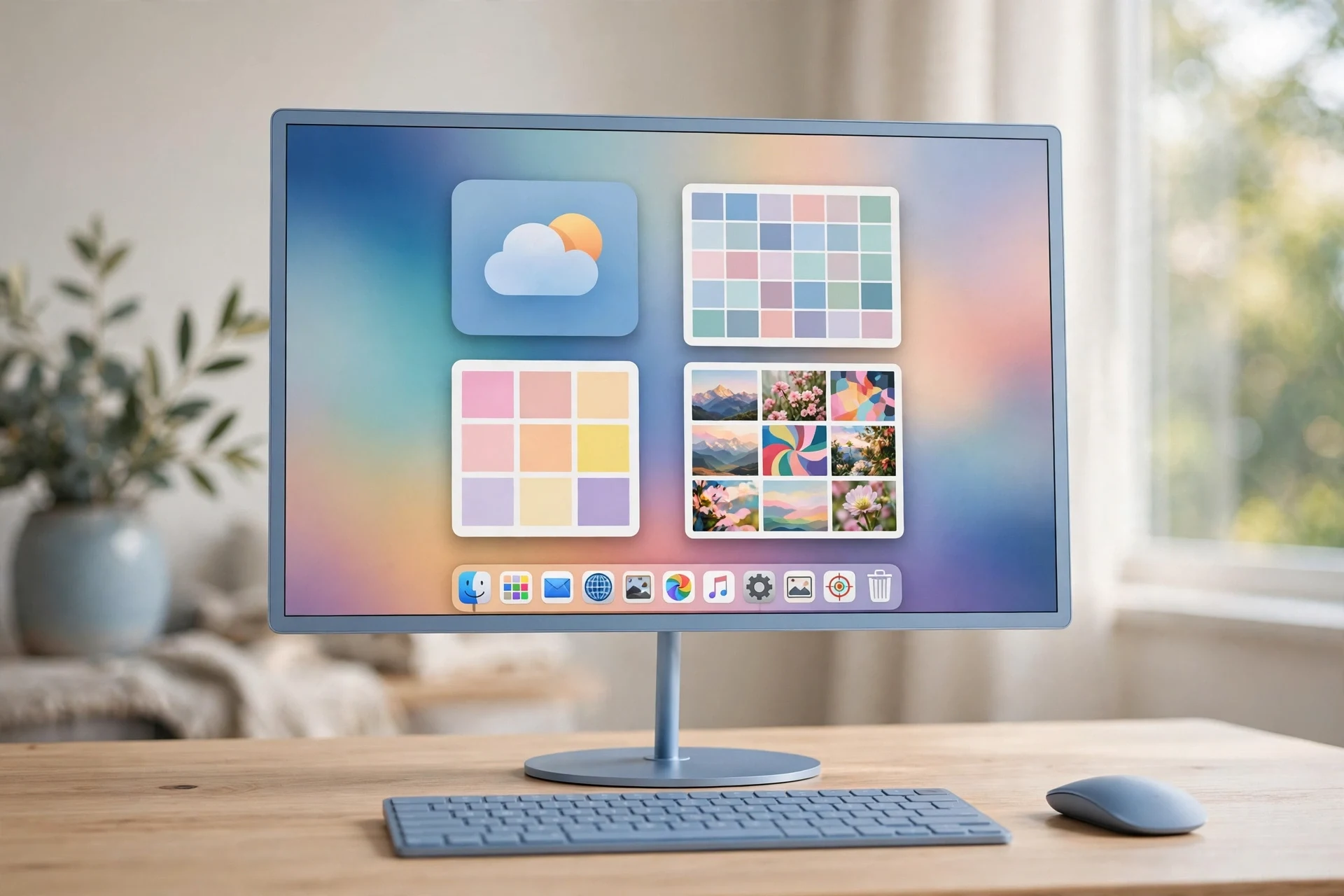
Nothing about the outside changed. The body is still 11.5mm thick on a slim stand, and the seven colors are the same as in 2024: blue, purple, pink, orange, yellow, green and silver.
The iMac M6 2026 keeps the same 24-inch 4.5K Retina panel: 4480-by-2520, 11.3 million pixels, 500 nits, P3 wide color and True Tone. Nano-texture glass remains an option, polishing cloth included. The 12MP Center Stage camera, three studio-quality microphones and six-speaker Dolby Atmos system are unchanged too.
Ports and Displays: Where the 12-Core Model Earns Its Price
Ports are where the two models split. Every iMac M6 2026 ships with at least two Thunderbolt 4 / USB 4 ports, but only the 12-core model adds two more, plus a 2.5Gb/s Ethernet port in the power adapter. Ethernet is an add-on for the 10-core model; the extra ports cannot be added.
Display support on the iMac M6 2026 follows the same split. The 10-core model supports one external display up to 6K at 60Hz; the 12-core model supports two 6K displays at 60Hz, or one 8K display at 60Hz. A 3.5mm headphone jack with high-impedance support sits on the side, and the N1 chip brings Wi-Fi 7 and Bluetooth 6. Accessories are color-matched, with a USB-C Magic Keyboard with wireless Touch ID.
iMac M6 2026 vs the Rest of Apple’s Desktop Line
The iMac competes with two machines from its own maker, and the comparison is really about the display. The Mac mini starts at $899 (approx. €825) with an M6 or M5 Pro chip, but it has no display, keyboard or mouse. Add a decent 4K or 5K monitor and the total lands close to $1,499.
The Mac Studio starts at $2,499 (approx. €2,300) with faster chips for demanding work, but it is much more expensive and also needs a display. It suits video professionals and developers needing sustained heavy compute.

Which iMac M6 2026 Should You Buy?
The decision tree is short: match the model to the work, not to the spec sheet.
Pick the 10-core iMac M6 2026 if:
- you mainly browse, write, stream and handle office work
- you use one external display or none at all
- you want the lowest price for the full iMac
- your photo editing is occasional rather than daily
Pick the 12-core iMac M6 2026 if:
- you edit photos or video regularly, or run local AI tools
- you need two external displays or an 8K display
- you want four Thunderbolt 4 ports and wired Ethernet
- you keep machines five years or more
At the same budget, prefer the 12-core 512GB model over the nano-texture 256GB model unless glare is a daily problem. Do not over-index on the chip alone: the $200 gap buys cores, ports and display support.
Pick the Mac mini if you already own a good display. Pick the Mac Studio only if your work pushes a machine hard for hours at a time.

Quick Answers
Is the iMac M6 2026 worth buying over the M4 model?
For new buyers, yes. The iMac M6 2026 adds a faster chip, faster memory and an upgraded SSD at the same $1,499 starting price, and MacRumors calls now a good time to buy. For M4 owners, the upgrade is hard to justify: design, display, camera and speakers are unchanged.
Which iMac M6 2026 model should most people buy?
The $1,699 12-core model with 256GB: two more CPU cores, two more GPU cores, two Thunderbolt 4 ports and a second external display.
When does the iMac M6 launch?
Pre-orders started October 28; launch day is November 6, 2026.
Should I buy an iMac or a Mac mini?
Buy the iMac M6 2026 if you want a complete setup with a built-in 4.5K display. Buy the Mac mini from $899 (approx. €825) if you already own a display.
The Takeaway
The iMac M6 2026 is a chip upgrade wrapped in a familiar body, and that is exactly what most buyers need. The M6 brings real speed for photo editing, AI work and ray-traced games, at the same starting price. The 10-core model is the value pick; the 12-core model is the pick for two displays or heavy creative work.
Buy the 12-core 512GB model if your budget stretches to $1,899 (approx. €1,750). Skip the upgrade if you own an M4 iMac.
Sources / Attribution
- MacRumors – iMac: Features, Price, and Buying Advice, accessed November 1, 2026.
- Apple – iMac product page, accessed November 1, 2026.
Performance multiples here are Apple’s claims (MF), not independent lab results.