Black Hole Collision GW250114: How One Merger Confirmed Einstein and Hawking
Two black holes merged about a billion light-years away, and the signal was clear enough to test two of the most famous predictions in physics at once.
On January 14, 2025, LIGO recorded a black hole collision called GW250114. Two black holes, each about 30 to 35 solar masses, spiralled together about 1 billion light-years away and merged into one larger hole. The signal was about four times clearer than the first merger detection a decade earlier.
The analysis confirmed two predictions: Hawking’s area law from 1971, about black hole surface area, and Einstein’s 1915 prediction that a disturbed black hole rings like a bell. The results appeared in Physical Review Letters on September 10, 2025, and CNN reported them the next day.
The Short Version
- GW250114: a black hole collision detected by LIGO on January 14, 2025, about 1 billion light-years away.
- Two black holes of 30 to 35 solar masses merged into one of around 63.
- Signal about four times clearer than in 2015.
- Confirmed Hawking’s area law (1971) and Einstein’s ringdown prediction.
- Paper in Physical Review Letters, September 10, 2025.
What This Black Hole Collision Was
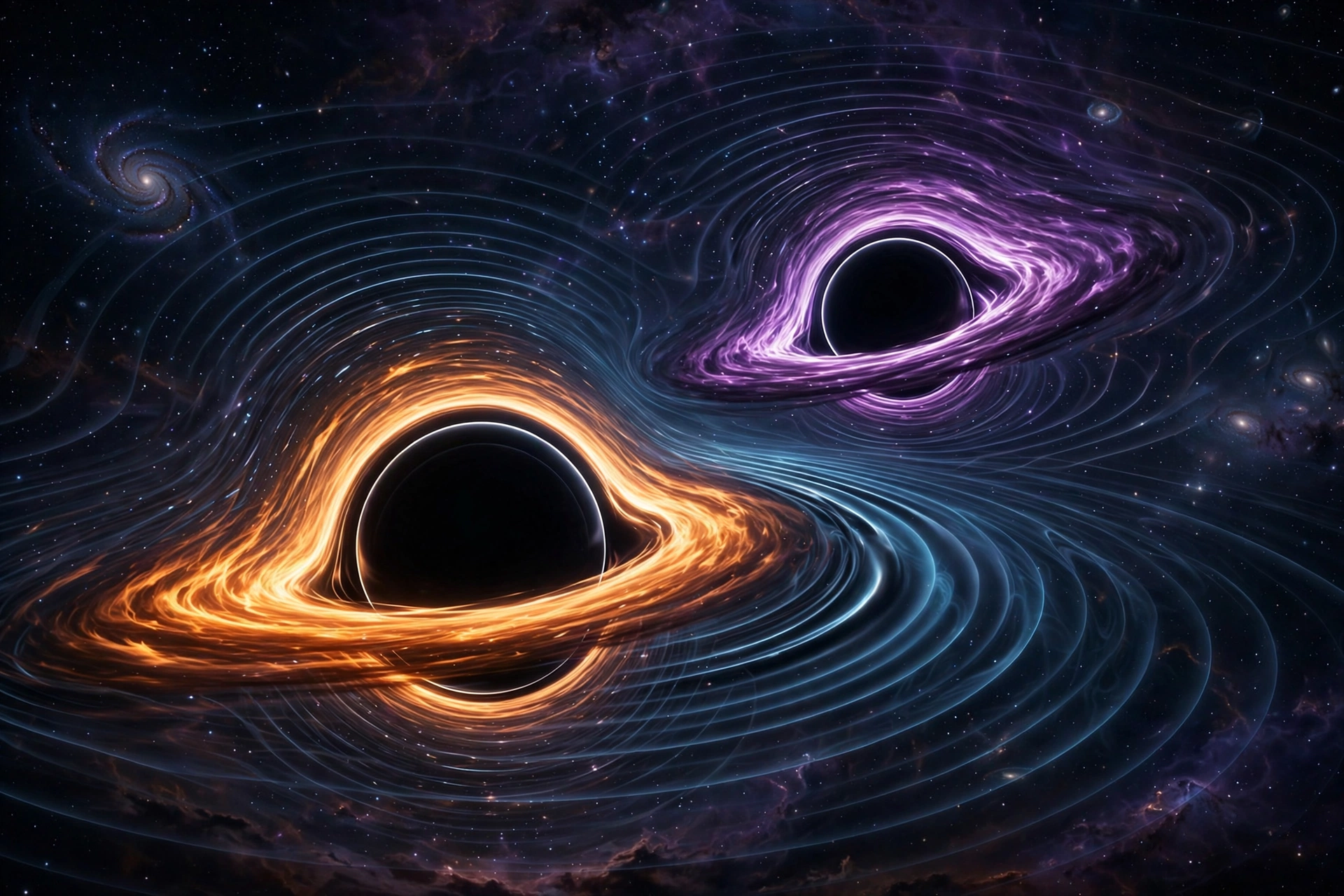
A black hole collision starts with two black holes orbiting each other. In GW250114, both spun slowly in almost a perfect circle, losing energy as gravitational waves, ripples in space-time, until they merged. The event lay about 1 billion light-years away, per Maximiliano Isi, though one report says 1.3 billion.
Each original was roughly 30 to 35 solar masses, though some reports say 30 to 40. The merged hole was around 63 solar masses, spinning at 100 revolutions per second. No telescope could see it: black holes emit no light. Only gravitational waves, predicted by Einstein in 1915, could reveal it.
How LIGO Heard the Black Hole Collision
LIGO runs two detectors, in Louisiana and Washington state. Each uses laser beams along long arms to measure tiny distance changes from a passing wave, which stretches space one way and squeezes it the other by far less than an atom’s width. Researchers match the signal against general relativity’s predictions.
For this black hole collision, the signal was unusually clean, about four times clearer than the first merger signal in 2015, though one source says three times. A clear signal separates the stages: inspiral, merger, ringdown. Isi, of Columbia and the Flatiron Institute, said via EurekAlert: “This unprecedentedly clear signal of the black hole merger known as GW250114 puts to the test some of our most important conjectures about black holes and gravitational waves.”
Hawking’s Area Law, Tested by a Black Hole Collision
In 1971, Stephen Hawking proposed a simple-sounding rule. When two black holes merge, the resulting hole’s surface area can never be smaller than the sum of the two that formed it. That surface is the event horizon, beyond which nothing, including light, can escape. It can never shrink, only stay the same or grow.
The idea connects to entropy, a measure of disorder. Hawking and Jacob Bekenstein proposed that surface area encodes entropy, which can only grow. If the law holds, black holes obey the same broad rules as everything else. For GW250114, the two originals covered about 240,000 square kilometres combined; the merged hole covered about 400,000. The area grew, so entropy rose, as the law requires.
Earlier checks: a tentative confirmation in 2019, using methods from Isi, Farr and colleagues, then a first observational confirmation in 2021 using LIGO data. The new result confirms the same law with much higher precision, because the signal was so much clearer. The EurekAlert release carries the full account.
The Ringdown: Einstein’s Black Hole Collision Prediction
The second prediction goes back to Einstein’s general theory of relativity, published in 1915. When a black hole is disturbed, by merging with another, it does not settle silently. It rings, like a struck bell, in a pattern called the ringdown. Its tone and fade depend on the final hole’s mass and spin, which general relativity predicts exactly.
The merged hole behaved as predicted. Its ringdown matched a Kerr black hole, Roy Kerr’s 1960s solution from Einstein’s equations: a spinning hole described entirely by mass and spin, with no extra features. Had it looked different, real black holes might carry structure the theory omits. Isi said, in comments reported by phys.org: “We’ve found some of the strongest evidence yet that astrophysical black holes are the black holes predicted from Albert Einstein’s theory of general relativity.” Lu said the results provide the best evidence yet for both hypotheses. The team claimed the strongest evidence yet, not absolute proof.
The Numbers
Confirmed, Reported, Unknown
Confirmed: the black hole collision happened, LIGO detected it on January 14, 2025, and the paper appeared in Physical Review Letters on September 10, 2025. Confirmed by measurement: the two originals covered about 240,000 square kilometres combined, the merged hole about 400,000, so the area grew. Confirmed by the ringdown: the remnant behaved like a Kerr black hole, consistent with general relativity.
Reported, with small differences: distance about 1 billion light-years per the team, 1.3 billion per one report; masses 30 to 35 solar masses each, 30 to 40 per some reports; clarity about four times better than 2015, three times per one source. Differences in rounding, not in what happened. Still unknown: what happens inside a black hole stays beyond observation, since nothing escapes the event horizon; the area law test concerns the surface, not the interior. Future signals may reveal deviations one event cannot show. The phys.org report carries Isi’s comments on the Kerr result.



The Bigger Picture
This black hole collision coincided with the 10-year anniversary of the first gravitational-wave detection in September 2015, which earned three of its scientists the Nobel Prize. In that decade the field became a precision science: the first signal proved the waves existed, the 2021 result first confirmed the area law, and GW250114 confirmed it with much higher precision plus a clean Kerr test.
Quick Answers
What was the black hole collision GW250114?
GW250114 was a black hole collision detected by LIGO on January 14, 2025. Two black holes of 30 to 35 solar masses each, about 1 billion light-years away, spiralled together and merged into one of around 63 solar masses, spinning at 100 revolutions per second.
How did this black hole collision confirm Hawking’s area law?
The team measured surface areas before and after the merger: the two originals covered about 240,000 square kilometres combined, the merged hole about 400,000. The area grew, exactly as Hawking’s 1971 law requires, and entropy rose as well.
What does the ringdown tell us about Einstein’s theory?
After the merger, the new black hole rang like a bell, and the pattern matched a Kerr black hole, the spinning solution Roy Kerr derived from Einstein’s equations in the 1960s. That match is strong evidence that real black holes behave as general relativity predicts.
The Takeaway
GW250114 was the clearest black hole collision signal recorded so far, letting researchers test two predictions that had waited decades for a good enough instrument. Hawking’s area law held: the merged surface was larger than the sum of its parts. Einstein’s ringdown held: the remnant rang like a Kerr black hole. Small reporting differences remain, but the direction is not in doubt.
Sources
- EurekAlert, Columbia University, September 10, 2025. https://www.eurekalert.org/news-releases/1097244
- phys.org, September 2025. https://phys.org/news/2025-09-black-hole-einstein-hawking.pdf
- LabOnline, September 2025. https://www.labonline.com.au/content/research-development/article/black-hole-collision-supports-hawking-s-landmark-theory-111877492
- UNILAD, September 14, 2025. https://www.unilad.com/news/world-news/breakthrough-black-hole-collision-501578-20250914
- CNN, September 11, 2025 (page not directly openable; facts use verified sources above). https://edition.cnn.com/2025/09/11/science/black-hole-collision-einstein-hawking