New Ice Age Stopped: How Warming Halted a Glaciation That Had Just Begun
Dead moss trapped under Arctic ice has given scientists a rare timeline of a glaciation in its first steps, and of the warming that cut it short.
By PetaTech24 Technology Desk | October 24, 2026
A new ice age stopped in the 1960s, according to a study published October 22, 2026 in the journal Science. Led by Nicolás Young of Columbia University’s Lamont-Doherty Earth Observatory, the research argues that the Barnes Ice Cap on Baffin Island in Canada began growing again about 2,000 years ago, before human-driven warming reversed that growth.
The Barnes Ice Cap is the last surviving remnant of the Laurentide Ice Sheet, which once covered much of Canada and the northern United States. At its largest, it stretched from above the Arctic Circle to Illinois, with ice more than two miles thick in places. Today it is about the size of Delaware, on Baffin Island in Nunavut.
That contrast is why the finding matters. Many model-based studies have placed the next glaciation thousands or tens of thousands of years in the future. Young and his colleagues argue for a different definition: the beginning is the first renewed growth of an ice sheet, not the moment a continent-spanning sheet has formed.
Key Takeaways
- The Barnes Ice Cap began growing again about 2,000 years ago, after reaching a minimum size about 3,000 years ago, researchers report.
- A new ice age stopped in the 1960s, when summer melting began to outpace winter snowfall on the cap.
- The cap’s edges have retreated an average of 4 meters per year since the 1980s, according to reporting on the study.
- Models cited by the researchers project the cap could disappear within the next few centuries if greenhouse gas levels stay high.
- The claim that this growth marked a new glacial period is the researchers’ interpretation, and it reframes, rather than settles, when glaciations begin.
How Researchers Read Dead Moss Under the Ice
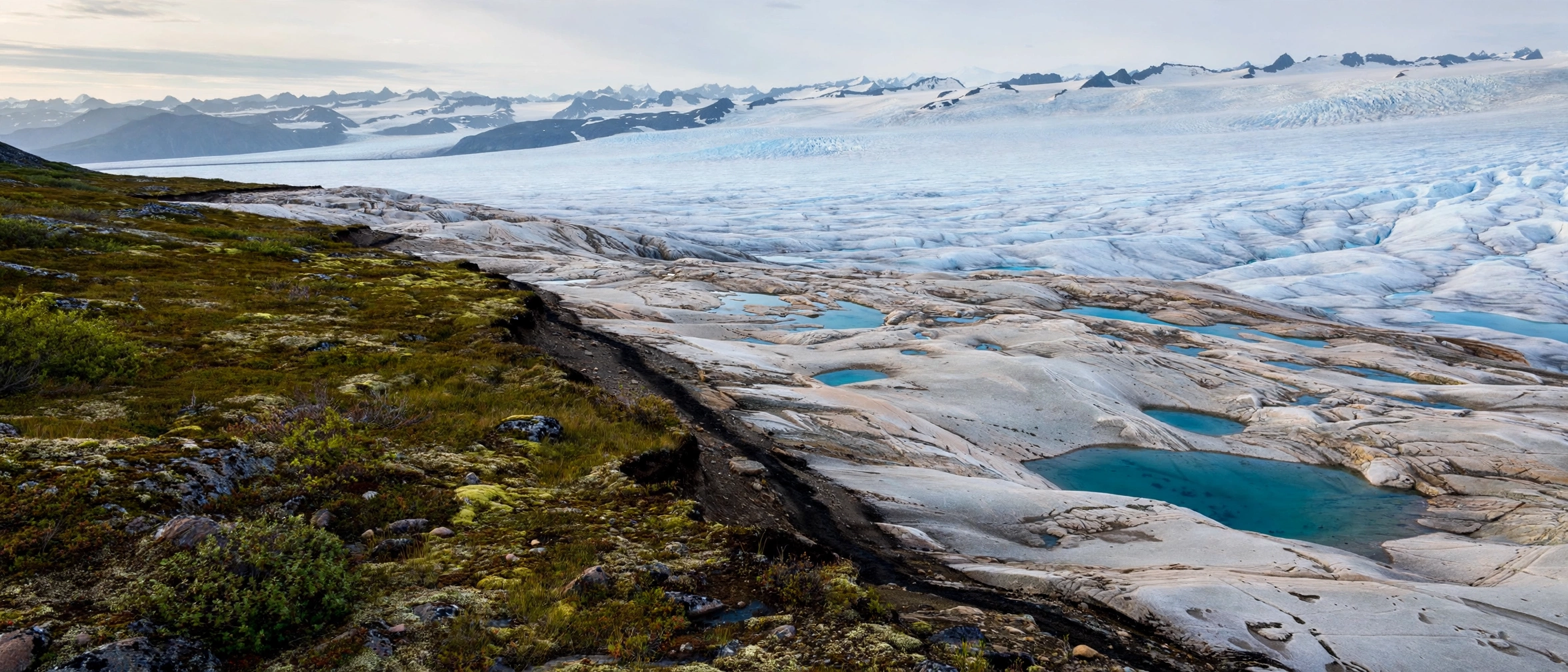
Reconstructing a glacier’s past is usually hard, because advancing ice scrapes away traces left on the landscape. The Barnes Ice Cap is an exception: frozen to its bedrock, it does not slide, so it preserves buried vegetation.
As the cap retreats, buried vegetation reappears at the ice margin. Mosses and small shrubs killed by advancing ice can be sampled and dated. Radiocarbon dating, measuring the breakdown of carbon-14, gives a kill date for each plant.
The team combined plant dates with beryllium-10 exposure dating of rock, which tracks how long a surface has faced cosmic rays. One wrinkle deserves note: Columbia dates renewed growth to about 2,000 years ago, while Colorado says kill dates show growth at least 1,000 years ago. The latter is a lower bound, so the two are compatible, but the timeline remains an estimate.
How the New Ice Age Stopped
For about 2,000 years, the slow driver was orbital change. Shifts in Earth’s rotation and orbit, known as Milankovitch cycles, gradually reduced Arctic summer sunshine. With less summer melt, winter snow survived year to year and piled up into ice.
By the 1960s, a faster driver had taken over. Rising summer temperatures meant the cap lost more ice in summer than it gained in winter. Historic aerial photos show the reversal: a prominent trimline marks the cap’s extent around 1960, and the ice has pulled back ever since. A new ice age stopped not with one dramatic event, but with a seasonal balance tipping the other way, year after year.
The pace since then is measurable. Reporting on the study puts the average retreat of the cap’s edges at 4 meters per year since the 1980s. That figure describes the Barnes Ice Cap specifically, not every Arctic glacier. That is how fast a new ice age stopped.
Young put the interrupted process in perspective. He said it would have taken thousands of years for the cooling to become noticeable, and about 30,000 years for the Laurentide to regain its continent-spanning mass. The glaciation was still in its infancy.
The New Ice Age Stopped in the 1960s: Cooling Versus Warming
Two forces pulled the cap in opposite directions in the middle of the twentieth century. Orbital cooling was still reducing summer sunshine, while rising greenhouse gas concentrations warmed the climate. For a time the two roughly balanced. Early studies in the 1950s and 1960s therefore described an exceptionally stable glacier, a reading the new research calls a snapshot of a rare moment.
Then warming won, and a new ice age stopped. The University of Colorado summary, from coauthor Gifford Miller’s institution, states that by the 1960s anthropogenic greenhouse gas emissions overwhelmed the cooling influence of Earth’s orbit. Miller called the result an illustration of the real power of greenhouse gases, a claim attributed here to the researchers.
Andrew Wickert, an associate professor of environmental science at the University of Minnesota Twin Cities who was not involved in the research, told Wired that the result is significant because warming had already reversed the major North American ice sheet’s growth even as emissions were just starting to ramp up.
The Bigger Picture
This study also revisits an old public debate. In the 1970s, some popular coverage warned that a new ice age might be imminent. Young told Columbia that, in a sense, that warning pointed at something real: the ice was indeed starting to grow again, even if scientists of that era could not prove it. A new ice age stopped before that slow process could become noticeable.
There is a second, longer consequence. The Laurentide served as a nucleation point for past glaciations: its cold mass helped sustain feedbacks that grew more ice. If the Barnes Ice Cap disappears, as models project it could within a few centuries under high greenhouse gas levels, a future glaciation would have to start without that last remnant. Researchers cannot say when the next glaciation might occur, and this article does not invent a date.
Readers should resist a tempting misreading. Warming interrupting a glaciation is not evidence that fossil fuel burning was beneficial, and the study team does not present it that way. The same warming is driving ice retreat worldwide, and the Barnes record shows how quickly a slow natural cycle can be knocked off course.

Confirmed, Argued, and Still Unknown
Separating evidence from interpretation matters here, because the headline version invites overstatement. The physical record is strong: dead vegetation, dated and mapped against a visible 1960 trimline, shows a cap that shrank, grew, then retreated. The interpretation that regrowth counts as the start of Earth’s next glacial period is a definitional argument, and a new ice age stopped is a phrase that carries that argument, so it should not be quoted without attribution.
One terminology point prevents confusion. Technically, Earth is still living in an ice age, the Late Cenozoic Ice Age, which began about 34 million years ago. Within it, colder glacial periods alternate with warmer interglacial periods, including the one we live in now. When this article says a new ice age stopped, it uses the popular meaning of that phrase, a new glacial period.

Quick Answers
Did humans really stop an ice age?
According to the study, a new ice age stopped when warming reversed about 2,000 years of Barnes Ice Cap growth in the 1960s. That is the researchers’ interpretation, not a claim that a continent-wide sheet was about to cover cities.
How do scientists know the ice was growing?
Dead mosses and shrubs buried by advancing ice reappear as the cap retreats. Radiocarbon dates show when the ice killed them, and beryllium-10 dates show how long rock surfaces were exposed.
When would the ice age have mattered?
Not soon. Young said cooling would have taken thousands of years to become noticeable, and about 30,000 years for the Laurentide to regain its former mass.
What happens to the Barnes Ice Cap now?
Models cited by the researchers project it could melt completely within the next few centuries if greenhouse gas levels stay elevated. That is a conditional projection, not a confirmed date.
What to Watch Next
Watch for responses from paleoclimate researchers outside the study team, especially on the definitional question: should first renewed ice growth count as the start of a glacial period, or should the start wait until continental sheets are forming?
Also watch for follow-up work on other Arctic ice caps, which could test whether the Barnes pattern was local or broader after a new ice age stopped. One well-preserved site is powerful, but replication across sites would strengthen the case.
The Takeaway
A new ice age stopped, the researchers argue, before it ever looked like an ice age. About 2,000 years of slow, orbitally driven growth on a remote Canadian ice cap ended in the 1960s, when summer warming tipped the balance from accumulation to loss. The evidence is tangible: dead plants, dated rock, and a visible line in the landscape.
That combination is why the story deserves careful reading. It shows human influence operating on a timescale usually reserved for geology, and how a definition can change a discovery’s meaning. The ice cap’s retreat is measured. The label on its earlier growth is argued.
Sources / Attribution
- Wired, Molly Taft, A New Ice Age Was Beginning. Then Humans Started Burning Fossil Fuels, October 2026.
- Columbia University, Lamont-Doherty Earth Observatory, Climate Change Stopped the Next Ice Age, October 22, 2026.
- University of Colorado, Institute of Arctic and Alpine Research, The failed ice age: Arctic ice was expanding for centuries before global warming stopped it, October 22, 2026.
- Young, Schaefer and colleagues, study published in the journal Science, October 22, 2026, as reported by Columbia and Colorado.