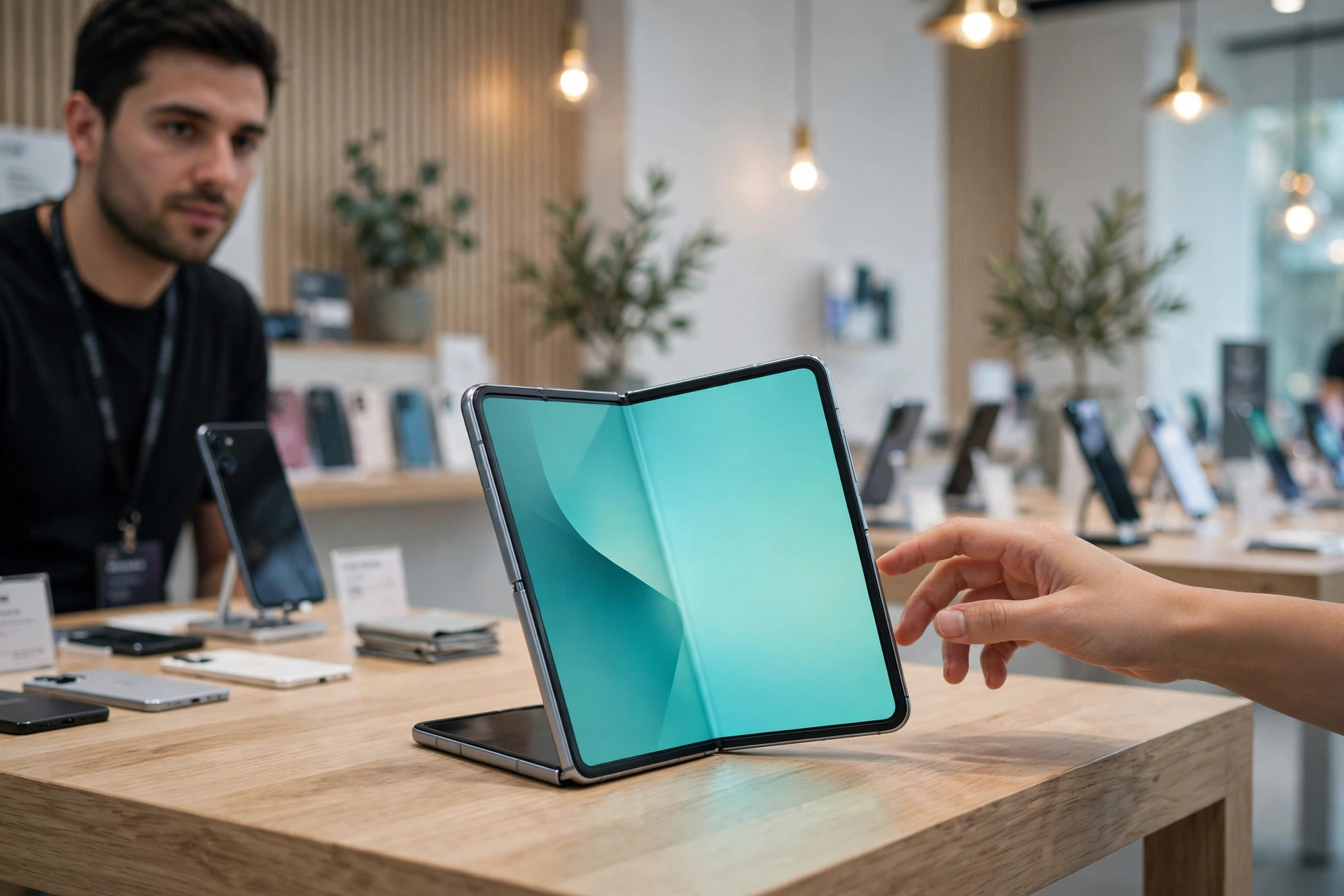
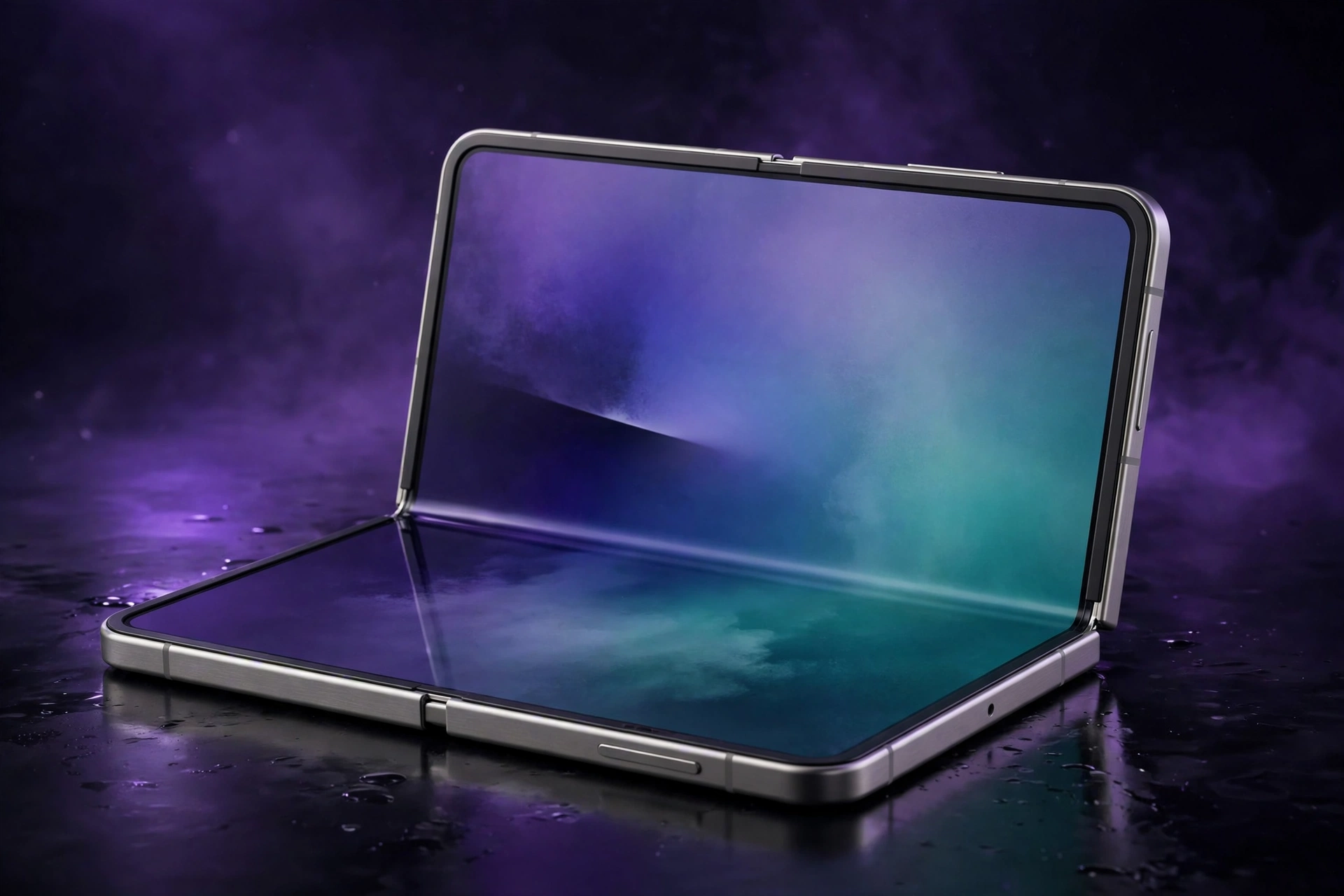
Apple’s first foldable iPhone has not reached store shelves yet, but the iPhone Duo 2 under-display Face ID project is already taking shape in the lab. Bloomberg reporter Mark Gurman says Apple is testing iPhone Duo 2 prototypes with Face ID sensors hidden beneath the outer display, a change aimed at the most criticized compromise of the first generation model. The hardware targets a successor expected next fall, though Apple has not decided whether the feature will ship, Gurman says.
The report, shared on Gurman’s Power On podcast and covered by MacRumors on October 22, describes prototype hardware, not a finished product. Prototype testing means it works in test devices, not that it has passed the cost, yield and reliability checks required before mass production.
The first iPhone Duo goes on sale on Friday, October 23, starting at $1,999 in the US and €2,299 in Germany. It unlocks with a fingerprint sensor in the side button, like the iPad, because the thin body leaves limited room for Face ID’s depth sensing hardware. The Duo 2 reporting suggests Apple began removing that compromise before the original model even launched.
In Brief
- Prototypes of the iPhone Duo 2 carry Face ID sensors under the outer display, according to Bloomberg’s Mark Gurman.
- The hardware is being tested for a fall 2027 successor, but the feature is not final and could slip to a third generation.
- The first Duo, on sale October 23 at $1,999 in the US and €2,299 in Germany, relies on Touch ID in the side button.
- An Action button is also under consideration for a future Duo, but those discussions sound less advanced.
- No Duo 2 price, camera or battery details have been reported.
Why the First Duo Skipped Face ID
Face ID is not a single camera. The TrueDepth system combines an infrared camera, a flood illuminator and a dot projector, and needs physical depth to map a face in three dimensions. On a conventional iPhone that hardware sits inside the Dynamic Island. On a foldable about 5.2mm thick when open, every fraction of a millimeter is contested by the hinge, display stack and battery.
A book style foldable also creates a duplication problem: the device is used open and closed, so biometrics ideally work in both states. Fitting two complete TrueDepth systems would add thickness, cost and power draw. Apple chose the simpler route: one fingerprint sensor in the side button, at the cost of the face unlock experience iPhone owners have expected since 2017.
Early reviewers noticed the trade immediately, and Duo coverage has repeatedly flagged the missing Face ID as its biggest compromise. Gurman’s reporting indicates Apple was working on the iPhone Duo 2 under-display Face ID fix in parallel.
What iPhone Duo 2 Under-Display Face ID Would Change
Moving the sensors beneath the outer display solves the closed phone problem first. Owners could unlock the Duo 2, approve payments and sign in to apps by looking at the cover screen. Gurman told his podcast audience the prototypes pair the Face ID sensor with an under-display camera on the outside screen, leaving the cover display free of cutouts.
The harder question sits on the inside. Current reporting places the prototype sensors under the outer display only, and no source has described Face ID hardware beneath the folding inner screen. Whether Touch ID stays as a second option for the unfolded position is an open question. Keeping both systems would cover each posture, at the cost of internal space Apple fought to save.
Sensors reading through a display panel receive less light than exposed ones, which is why under-display cameras lagged for years. Face ID allows less room for error than a selfie, because a false read is a security failure. That reliability bar likely explains why the iPhone Duo 2 under-display Face ID feature remains a prototype rather than a promise.
The Bigger Picture
The Duo 2 prototypes did not appear from nowhere. Apple has been shrinking the TrueDepth system in public for a year on the road to the iPhone Duo 2 under-display Face ID system: the iPhone 18 Pro, launched last month, uses a smaller infrared camera and a reduced Dynamic Island. Reporting has also linked the same under-display technology to a special anniversary iPhone expected in 2027.
In September, Gurman predicted smaller components and advances in on-device AI would let Apple add Face ID and a dedicated telephoto camera to the foldable line by the third generation. Working Duo 2 prototypes suggest the Face ID half of that roadmap may arrive a generation early. The telephoto half is less clear, with no current report tying a dedicated zoom lens to the second generation.
The Action button sits in a weaker category of evidence. Gurman says Apple is considering the control for a future Duo, and its absence on the first model is conspicuous when every Pro iPhone ships with one. Internal discussion is a softer signal than hardware already built into test devices, and the two should not be weighted the same way.
What Is Still Unknown
Apple has not commented on the Duo 2, and Gurman’s reporting carries an explicit caveat: whether the iPhone Duo 2 under-display Face ID system ships in the second generation is not finalized. If testing or production runs late, the feature could slip to the Duo 3, restoring the September roadmap. Pricing is equally open, and no report has yet put a figure on the successor.
For buyers deciding this week, the read is straightforward: the first Duo’s Touch ID setup is a known quantity and the phone can be bought on Friday. Anyone who ranks face unlock above every other feature, and can wait a year, now has a reported reason to hold off. Everyone else is choosing between the foldable Apple actually sells and a prototype that may still change.
Frequently Asked Questions
Does the iPhone Duo 2 have under-display Face ID?
Not officially. Bloomberg’s Mark Gurman reports that Apple is testing iPhone Duo 2 under-display Face ID prototypes with sensors beneath the outer display, but the feature is not finalized and Apple has not announced the device.
When is the iPhone Duo 2 expected to launch?
The successor with iPhone Duo 2 under-display Face ID is expected next fall, pointing to fall 2027. The timing is reported rather than confirmed, and could move if testing runs late.
Why does the first iPhone Duo use Touch ID instead of Face ID?
Its thin folding body leaves limited space for the TrueDepth hardware. Apple placed a fingerprint sensor in the side button instead, the same solution used on the iPad.
How much does the iPhone Duo cost?
The first generation Duo starts at $1,999 in the US and €2,299 in Germany, on sale from October 23, 2026. No Duo 2 price has been reported.
Will the iPhone Duo 2 get an Action button?
Gurman says Apple is considering an Action button for a future Duo. The discussions appear less advanced than the Face ID work, so the button is a possibility, not an expectation.
Sources
MacRumors, iPhone Duo 2 Prototypes Include Under-Display Face ID, October 22, 2026, reporting Bloomberg’s Mark Gurman, Power On podcast. Corroborating coverage: NotebookCheck, iPhone in Canada, PhoneArena and Macworld, October 22, 2026. Duo pricing and dates: GSMArena, October 16, 2026. All Duo 2 details here are prototype reports, unconfirmed by Apple.