
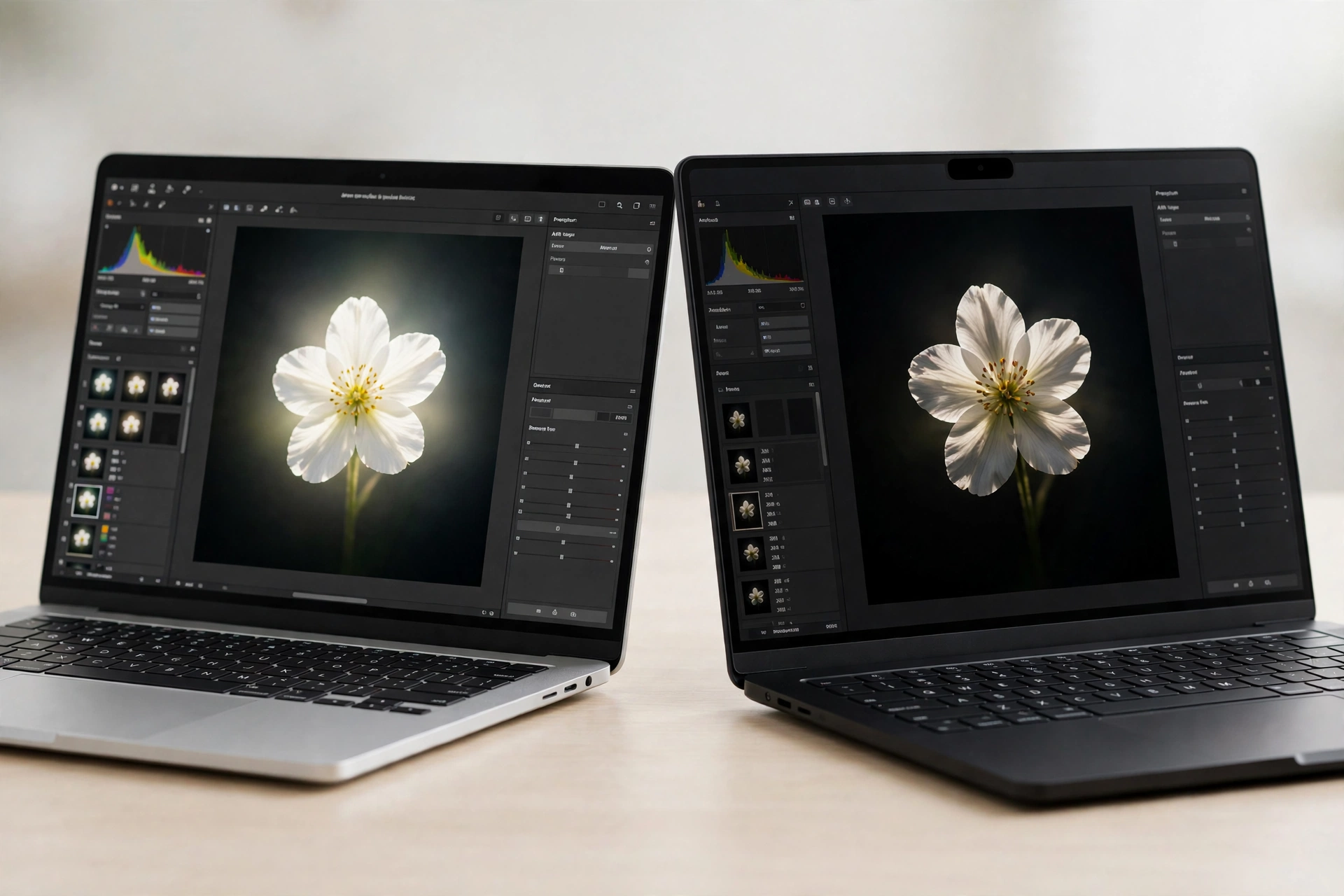
MacBook Pro mini-LED vs OLED: Apple now sells the same Pro laptop with two very different screens. The chips did not change, the price did.
MacBook Pro mini-LED vs OLED is the choice Apple has put in front of Pro buyers: a display decision, not a speed decision. Apple announced PROLED XDR on October 28, 2026, for sale from November 6, while the mini-LED models from March 11, 2026 stay on sale.
Both run the same M5 Pro and M5 Max chips, so equivalent configurations deliver essentially the same processing performance. Memory tops out at 128GB on both, and Apple rates battery life the same. That leaves the MacBook Pro mini-LED vs OLED decision to the screen, touch, weight and price.
The premium is $400 at every tier in the United States: the 14-inch M5 Pro starts at $2,499 or $2,899, the 16-inch at $2,999 or $3,399, and M5 Max models at $4,099 or $4,499 in 14-inch and $4,399 or $4,799 in 16-inch.
The Short Version
- Same chips, same speed: M5 Pro and M5 Max in both, so the MacBook Pro mini-LED vs OLED decision is about the screen, not performance.
- PROLED adds tandem OLED, touch, a Dynamic Island, Adobe RGB and a lighter body.
- Mini-LED stays $400 cheaper at every tier in the US, and €400 to €500 cheaper in Germany and Austria.
- PROLED is the only way to get 16TB of storage or genlock.
- Recent M5 owners have little reason to switch.
The Bigger Picture
MacBook Pros have used mini-LED since 2021, with the design largely unchanged for five years. This is the first time buyers can choose between two display technologies in one Pro lineup, and the first time any Mac has a touchscreen.
The stakes are practical: a Pro display is the part a buyer looks at for hours every day, and the part Apple changed most. For photo and video editors grading HDR, the MacBook Pro mini-LED vs OLED comparison starts with contrast and color, and only then moves to price.
MacBook Pro mini-LED vs OLED: The Display Decides It
The MacBook Pro mini-LED vs OLED display gap starts with how light is made. Mini-LED is an LCD with a backlight split into local dimming zones; PROLED is a tandem OLED panel with two self-illuminating pixel layers, so each pixel controls its own light. Contrast jumps from 1,000,000:1 to 10,000,000:1, and peak HDR brightness from 1,600 nits to 2,000 nits.
Both panels hold up to 1,000 nits of sustained full-screen HDR brightness, so the OLED screen is not twice as bright in every task. PROLED adds Adobe RGB beside P3, plus reference modes for HDR photography, DICOM imaging and Apple CMF 2026.
A Lighter Body, a New Hinge and a Lit Logo
Weight is the second-biggest change, and the one buyers will feel daily. The 14-inch M5 Pro drops from 1.60kg to 1.38kg, and the 16-inch M5 Pro from 2.14kg to 1.82kg. M5 Max models fall from 1.62kg to 1.40kg and 2.15kg to 1.84kg.
Thickness barely moves: 1.55cm to 1.50cm on the 14-inch, and 1.68cm to 1.60cm on the 16-inch. Apple redesigned the hinge for touch stability, reworked cooling so warm air moves away from the display, and brought back the illuminated rear Apple logo.
Touch, Dynamic Island and the Camera Fix
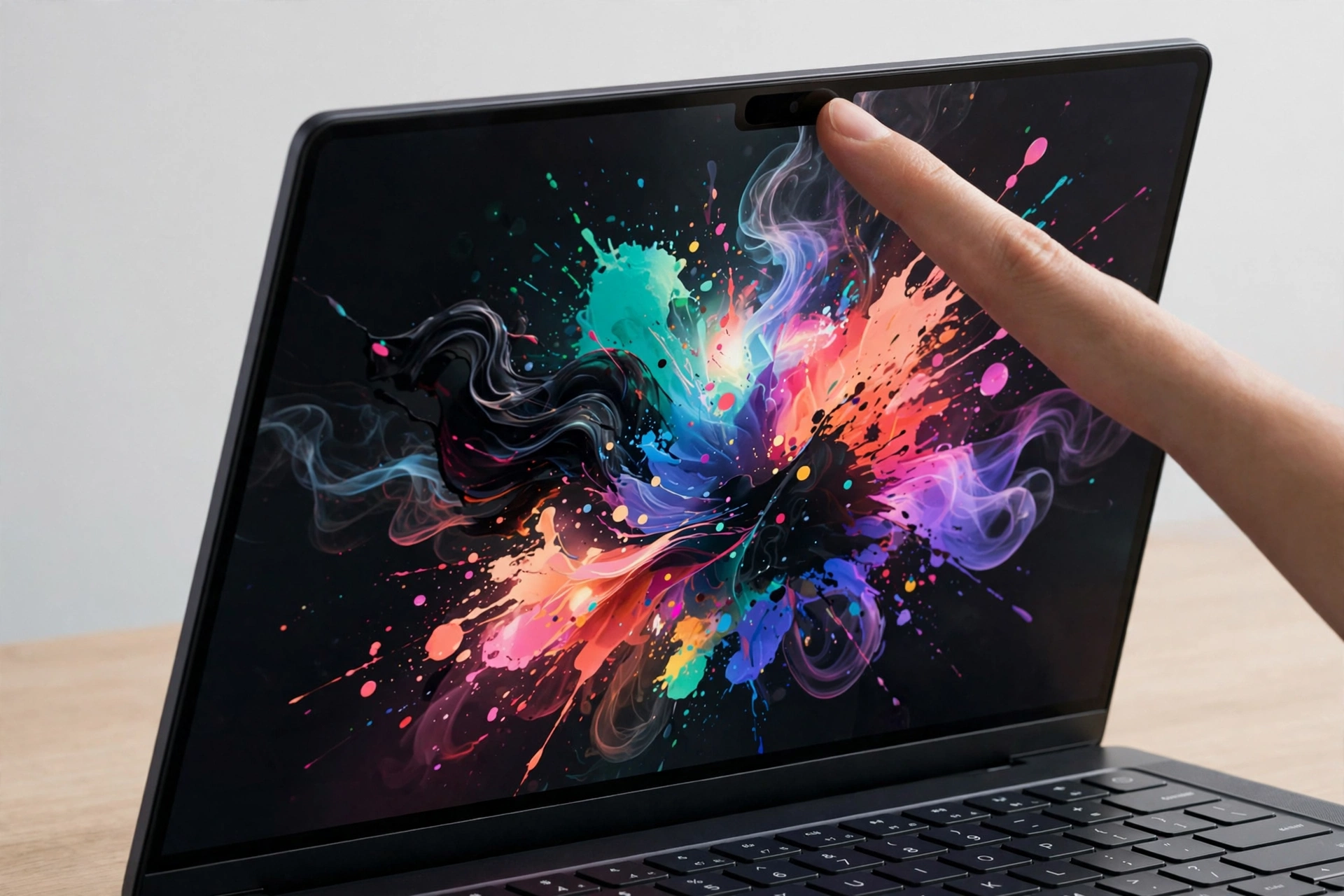
Touch is the most visible new feature in the MacBook Pro mini-LED vs OLED comparison, but it is worth describing plainly. The Multi-Touch sensor sits inside the panel rather than layered on top, which Apple says cuts latency. macOS translates touches into clicks, so existing apps should respond to taps. Apple lists swipe, pinch to zoom, drag and drop, double-tap to fill and flick to tile.
Developers get touch gesture APIs for app-specific interactions. The Dynamic Island holds Live Activities, music, phone calls and AirDrop requests, and Spotlight moves into the island when Siri AI is available and enabled. The 12MP Center Stage camera gains stabilisation to stop the feed shaking while the screen is touched.
In the MacBook Pro mini-LED vs OLED decision, touch is a bonus, not the deciding factor.
Sound, Storage and the 16TB Ceiling
Speakers are a smaller part of the MacBook Pro mini-LED vs OLED story, but Apple changed them anyway. The new woofers deliver 50% deeper bass, according to Apple, and the tweeters are reshaped to spread sound more clearly, with dedicated tuning for closed-lid use with an external display.
Storage is where PROLED opens a gap for a small group. M5 Max goes up to 16TB on PROLED, against 8TB on mini-LED. M5 Pro storage stays at 1TB, 2TB or 4TB on both. External display support rises from 144Hz to 165Hz, and PROLED adds genlock, which synchronises display refresh with camera capture.
Battery is the one area with no winner. The 14-inch battery is 72.4Wh on mini-LED and 72.6Wh on PROLED, and MacRumors notes the slightly larger cell does not increase endurance. Apple rates battery life the same on both, and the 16-inch M5 Max minimum recommended charging rises from 70W to 94W. Full comparison: the MacRumors guide; official figures: Apple’s specifications page.
MacBook Pro mini-LED vs OLED: The Price Question
United States prices put the MacBook Pro mini-LED vs OLED gap at $400 at every tier: 14-inch M5 Pro $2,499 or $2,899, 16-inch M5 Pro $2,999 or $3,399, 14-inch M5 Max $4,099 or $4,499, 16-inch M5 Max $4,399 or $4,799. Mini-LED prices have risen since March, so launch-price comparisons would overstate the premium.
In Germany and Austria, the same four configurations cost €2,899 or €3,299 (14-inch M5 Pro), €3,399 or €3,899 (16-inch M5 Pro), €4,799 or €5,199 (14-inch M5 Max) and €5,099 or €5,599 (16-inch M5 Max), per Apfelpatient. The PROLED premium is €400 on 14-inch models and €500 on 16-inch models. These were not verified directly on Apple German store pages.
The MacBook Pro mini-LED vs OLED price gap is small next to a memory or storage upgrade. The $400 saved can go toward more memory or a higher chip tier, and that trade is usually better for desk-bound work.
MacBook Pro mini-LED vs OLED: Who Should Buy Which
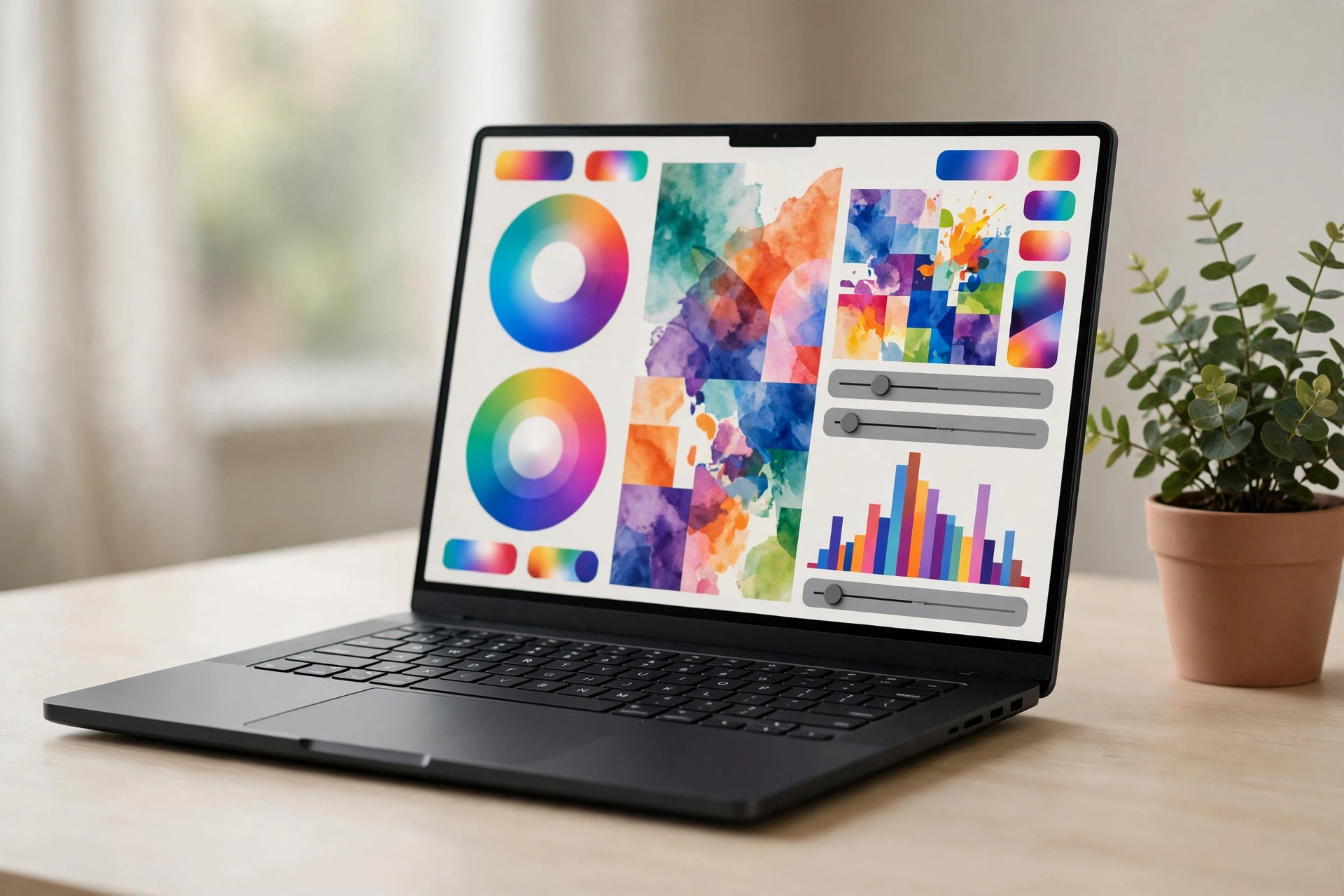
The MacBook Pro mini-LED vs OLED verdict is conditional, because the two machines share a chip and differ in the screen. Pick PROLED if the display is your working surface; pick mini-LED if the saving buys a better configuration.
Pick the PROLED model if:
- You grade color, edit photos or HDR video, or need Adobe RGB.
- You need more than 8TB of internal storage, or genlock for camera work.
- You carry a 16-inch machine daily and the 320g weight cut matters.
- You buy new, live on the built-in display, and the $400 premium is affordable.
Pick the mini-LED model if:
- You work mostly on an external monitor.
- A discount makes the saving large.
- You own a March 2026 M5 model that still handles your work.
- Touch holds no value in your workflow.
Owners of M1, M2 or M3 MacBook Pros face a different question: the MacBook Pro mini-LED vs OLED choice still matters, but the chip jump to M5 Pro or M5 Max matters more, and it is the same on both models. Waiting is also legitimate, since M7 Pro and M7 Max models are reportedly planned for late 2027, but that is reported, not confirmed.

Quick Answers
Is MacBook Pro mini-LED vs OLED a speed difference?
No. Both use the same M5 Pro and M5 Max chips, so equivalent configurations deliver essentially the same processing performance. The difference is the display, touch, weight and price.
How much more does the PROLED model cost?
$400 more in the US at every tier, from $2,899 against $2,499 for the 14-inch M5 Pro. In Germany and Austria it is €400 on 14-inch models and €500 on 16-inch models, per Apfelpatient.
Does the OLED model last longer on battery?
No. Apple rates battery life the same on both; the 14-inch battery is 72.4Wh against 72.6Wh, with no endurance gain, per MacRumors.
Should I upgrade from a March 2026 M5 MacBook Pro?
In a MacBook Pro mini-LED vs OLED upgrade decision, the chips are the same, so upgrade only for the OLED display, genlock or storage above 8TB.
The Final Word
MacBook Pro mini-LED vs OLED comes down to one question: how much is the screen worth to you? PROLED is the better display, the lighter machine and the only touchscreen Mac, at $400 more per tier. Mini-LED is the same computer with a very good screen for $400 less.
Either way, the MacBook Pro mini-LED vs OLED choice is a screen choice. Buy PROLED if you are buying new and live on the built-in display. Buy mini-LED if the saving buys a better configuration or a discount widens the gap.
Sources / Attribution
- MacRumors, MacBook Pro Mini-LED vs. OLED Buyer’s Guide: Every Difference, October 29, 2026. Primary comparison source: display, design, weight, audio, storage, prices, launch dates and upgrade advice.
- Apple, MacBook Pro with Liquid Retina XDR Display, Technical Specifications. Official mini-LED spec sheet: contrast, brightness, resolution, battery, weight and external display support.
- Apfelpatient, MacBook Pro PROLED XDR vs. Mini-LED: Is the extra cost worth it?, October 2026. Germany and Austria EUR prices, taken from Apple German technical specifications and store pages.
- Mac Observer, Touchscreen MacBook Pro is official: PROLED OLED model starts at $2,899, ships November 6, October 30, 2026. Corroboration of US starting prices and launch date.
- 9to5Mac, Apple announces all-new MacBook Pro with PROLED XDR display, its first touchscreen Mac, October 28, 2026. Announcement corroboration.
Methodology note: display and price figures come from MacRumors and Apple spec sheets. The 50% deeper bass figure is an Apple claim, not an independent measurement. M7 Pro and M7 Max for late 2027 are reported, not confirmed. EUR prices come from a secondary source and were not verified directly on Apple German store pages.