
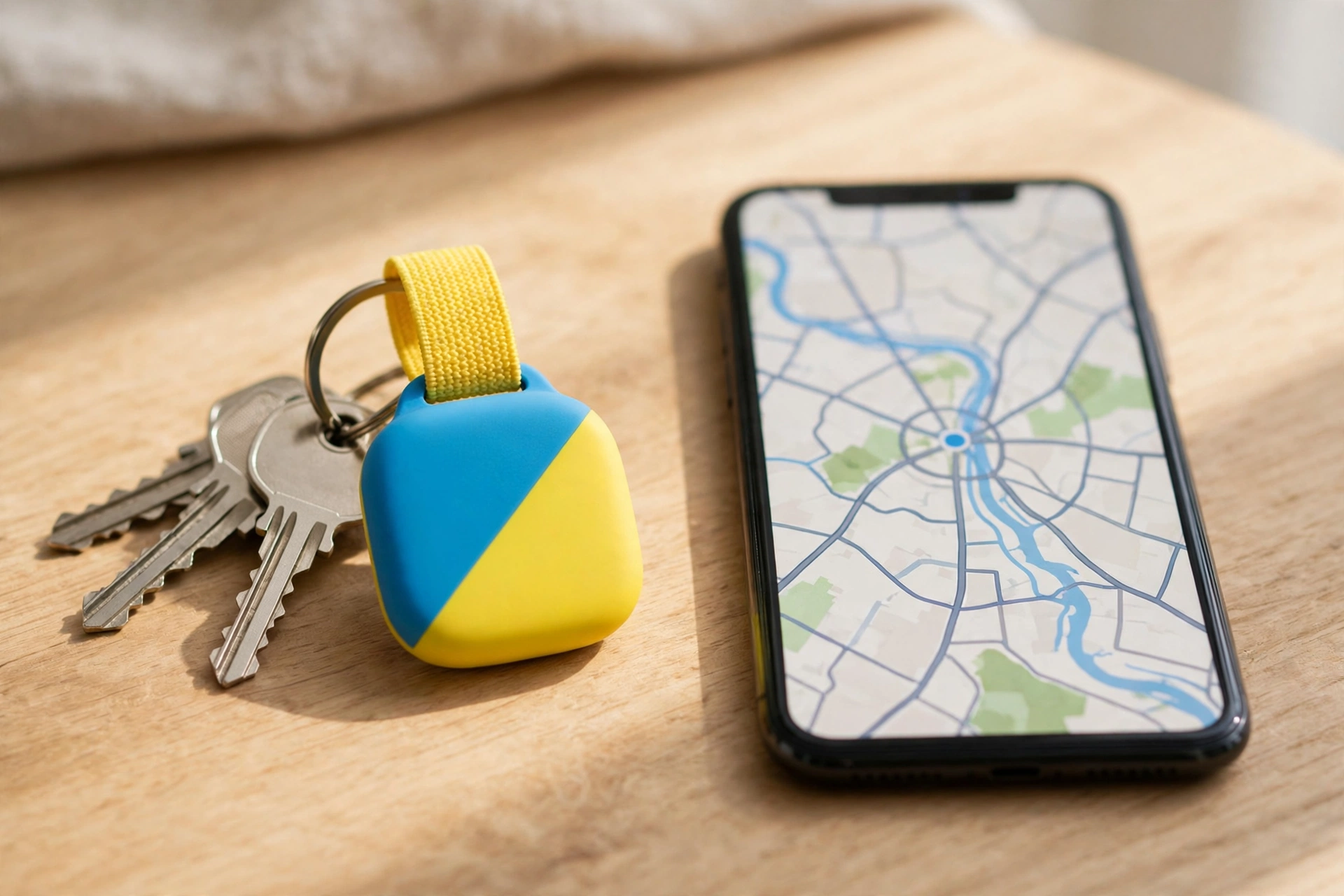
A 20 dollar AirTag alternative has turned one reviewer into a convert, for reasons that go beyond price. In a hands-on published by MakeUseOf on October 23, 2026, author Rob LeFebvre tests the Roam tracker, a small UK-designed tag that works with Apple Find My and Google Find Hub. Roam sent the review unit, but its public relations team had no say in the article and did not see it ahead of publication.
The headline price needs explanation first: a single Roam costs $29.99 in the United States, one dollar more than a single AirTag at $29, while $20 is the five-for-four bundle rate of $19.99 per tracker. One tag alone will not cost $20.
His verdict is personal, not a laboratory result: he now prefers Roam and plans to buy four or eight more if the deals continue. PetaTech24 has not tested either tracker, so this article reports his observations and flags what the hands-on does not prove.
The Short Version
- This 20 dollar AirTag alternative works with Find My or Find Hub, no extra app, no subscription, but one network at a time.
- Built-in elastic strap, so no holder purchase is needed.
- A visible QR code lets any finder scan it, no NFC tap needed.
- Louder than the original AirTag in the author’s three-location sound test.
- Both use a CR2032 battery, lasting around a year.
- Bundle pricing is promotional and could end.
Why This 20 dollar AirTag alternative Caught Attention
New AirTags launched this past January with a louder speaker and longer finding range, yet Roam still does several things Apple does not, per the author: dual-network choice, a built-in strap, a QR code, bright colors, and a louder sound than the original AirTag.
That matters most for mixed-phone households, where one brand can be set up per phone and per tag, colors coded by network. Roam is not the only dual-network tracker, though: Chipolo Pop and Pebblebee Tag Universal also support both networks, per the author.
One Tag, Two Phone Worlds
Roam pairs with Find My and Find Hub with no extra app and no subscription, per the author. AirTags require an iPhone or iPad running iOS or iPadOS 26 and above, while Android users can only read an AirTag via NFC in Lost Mode. For mixed iPhone and Android households, that gap is practical.
The catch: Roam uses only one network at a time, so each tag must be set to Apple or Google, and switching means removing it from one network and pairing it to the other, which Roam says takes less than a minute. The author used Find My, and the tag was ready right away. That flexibility is the core pitch of this 20 dollar AirTag alternative, even though no single tag is universal at any one moment.

The Strap Changes Daily Use
Roam has a built-in elastic strap looping around a key chain, zipper pulls, bike rails, and bag handles. AirTags are minimal, with no easy attachment point, so buyers need a keyring; Apple retails its keyring for $35. For the author, this 20 dollar AirTag alternative wins here because attachment is included.
The strap makes Roam a little bulkier than a bare AirTag, but the author reports no snagging on luggage, a backpack, or keys, and little functional size difference once an AirTag sits inside a holder. So far the elastic has stayed stretchy and tight, but that is short-term observation, not a durability test.
The Bundle Maths Behind This 20 dollar AirTag alternative
Single-unit pricing tells a different story: a single Roam at $29.99 costs one dollar more than a single AirTag at $29, while an AirTag four pack brings each unit to $24.75. Roam’s five-for-four bundle is $19.99 per tracker, and eight-for-six is $14.99 each. The 20 dollar AirTag alternative label is the five-for-four rate, rounded to the nearest dollar.
Skipping a holder widens the gap for key users, though not every buyer needs one. Roam pricing is promotional and could end, the author warns. The source gives United States prices only, so this article gives no Europe price and does not convert dollars into euros as a local price.
A QR Code Any Finder Can Use
Each unit of this 20 dollar AirTag alternative gets a unique QR code anyone can scan with a phone camera. On scanning, the owner gets an email with a what3words location within a 3-meter square, and the finder sees a custom owner message. The author stresses simplicity: a visible QR code is a gesture almost every phone user knows.
Apple has something similar for non-Apple users, but it requires NFC, and finders see contact info only after the owner switches on Lost Mode and the finder knows to tap the white side. iPhone owners can use Find My, then Items, then Identify Found Item, but must still switch on Lost Mode first. That extra step is where this 20 dollar AirTag alternative pulls ahead, per the author.
Louder, Brighter, and Easier to Open
Sound is where the author is most direct, and where readers should read the fine print: he tested Roam against his original AirTag, not a newer, louder AirTag. He placed each tag in the garage, under the couch, and deep in a cross-body bag on a coat rack; in each case, Roam was much easier to hear and find. He relies on audible finding for keys and in-ear monitors, so that result alone was worth the price.
Color is the softer advantage: Roam comes in black, blue, green, pink, gray, and yellow, shades the author compares to macaron desserts, while Apple sells only white and silver. Designer Tangerine says the body uses 100% recycled plastic, against 85% in Apple’s enclosure, as reported in the article, not from an independent materials test.
Battery access closes the practical case. Both use a CR2032 battery and last around a year, so that point is a wash, but Roam is much easier to open, according to the author, which matters when a tag dies as you head out the door.
What This 20 dollar AirTag alternative Does Not Prove
Honest limits matter because the story rests on one reviewer and one supplied unit. The author did not test the newer, louder AirTag, gave no finding-range numbers, ran no long-term strap test, and measured no battery life beyond the around-a-year expectation. The source covers no dimensions, weight, water resistance, or precision finding, so this article claims none.
Price is the other limit: bundle rates are promotional, the single-tag price exceeds the headline figure, and only United States prices appear in the source. Buyers elsewhere should check local pricing before assuming the $20 framing applies, since the author gives no Europe price.
Quick Answers
Is the 20 dollar AirTag alternative really $20? Only as a bundle rate: five-for-four is $19.99 per tracker, while a single Roam is $29.99 in the United States, one dollar more than a single AirTag.
Does Roam work with both iPhone and Android? Yes, through Apple Find My or Google Find Hub, with no extra app and no subscription, but each tag uses one network at a time, with switching under a minute, according to Roam.
Is Roam louder than an AirTag? The author found it much louder than his original AirTag in a garage, under a couch, and inside a cross-body bag, but he did not test the newer, louder AirTag.
Do you need a holder for Roam? No: the built-in strap loops onto keys, zippers, bike rails, and bag handles, while an AirTag needs a holder, with Apple’s keyring at $35.
The Takeaway
On the author’s evidence, this 20 dollar AirTag alternative makes its strongest case for mixed-phone households, buyers who hate buying holders, and people who find things by sound. For a single-tag buyer, someone already stocked with holders, or anyone deciding on the newer AirTag’s volume and range, his test does not settle it.
Price the bundle you will actually buy, check the promotion is still live, and weigh the one-network limit. If those checks pass, his conclusion is clear: a cheaper bundle, a louder sound, and a strap in the box is practical, though PetaTech24 has not verified it firsthand.
Sources: MakeUseOf, Rob LeFebvre, “I tried a $20 AirTag alternative,” October 23, 2026. Observations are attributed to the author; prices are United States prices as reported there.