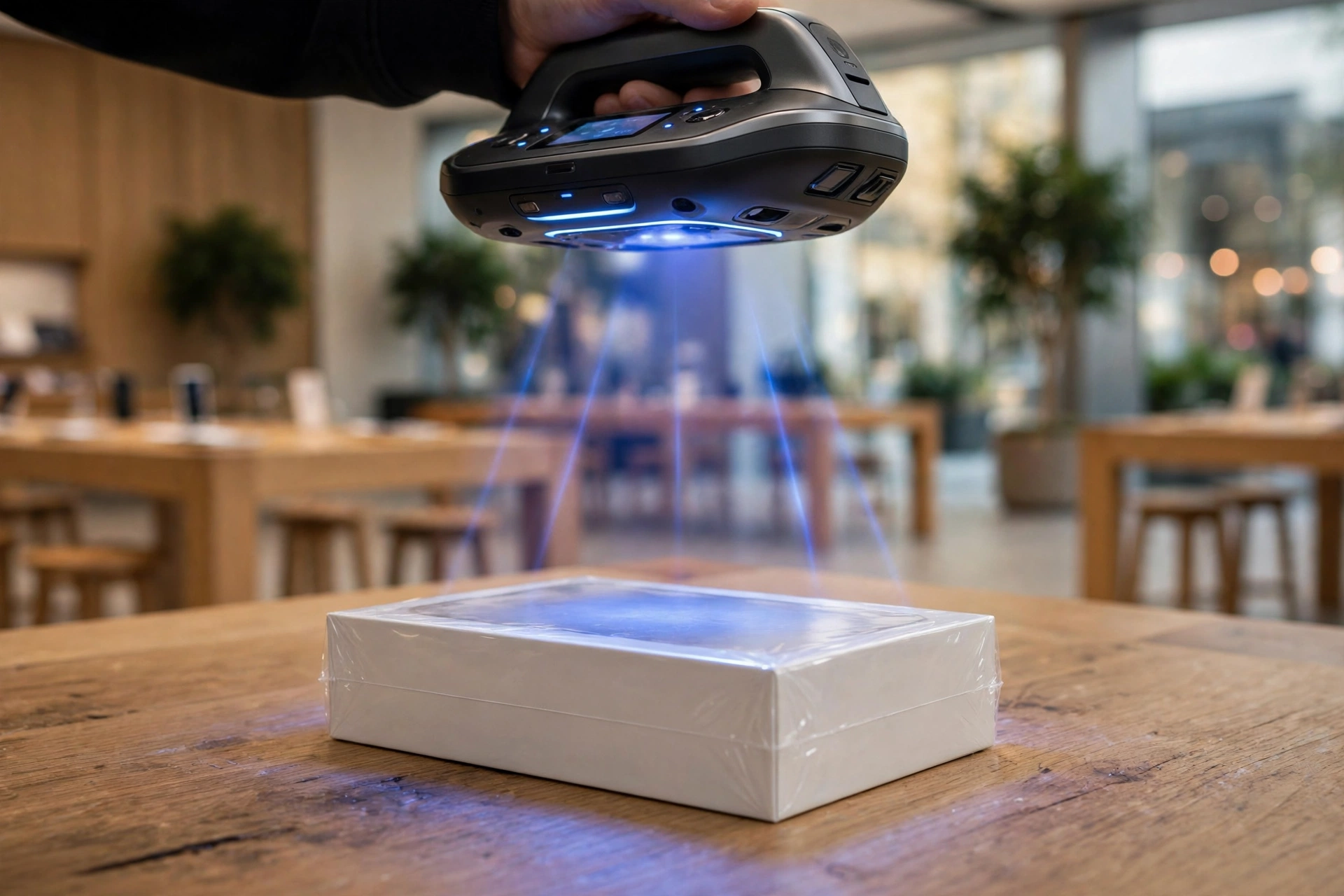
Apple is reportedly rolling out a new retail scanner that can inspect an iPhone inside its sealed box, and the Apple anti-theft system is aimed at a costly store problem rather than at your phone. According to Bloomberg reporter Mark Gurman, covered by Forbes on October 25, 2026, the devices began arriving at Apple stores earlier in October and are now becoming operational. Store staff can run diagnostics on a boxed iPhone without breaking the seal.
The problem behind the Apple anti-theft system is return fraud at scale. Gurman reports that some buyers remove accessories, strip components, or take the phone itself, then reseal the packaging and return it, sometimes reselling the parts through aftermarket channels. Until now, staff often had to open even sealed boxes to verify what was inside, and opening a box can push an otherwise sellable phone into extra processing before it can be sold as new again.
Apple has not publicly announced the scanner, and it has not detailed exactly what its diagnostics can detect. That matters for how this story should be read. Everything about how the device works comes from Gurman reporting, not from an Apple statement, and the limits of the checks remain undisclosed. The reported job is simple: keep genuine sealed stock sealed, and flag suspicious returns faster.
In Brief
- Bloomberg reporter Mark Gurman reports the Apple anti-theft system is a retail device that scans sealed iPhone boxes and runs diagnostics on the phone inside.
- The devices began arriving at Apple stores earlier in October 2026 and are now becoming operational, according to the same reporting.
- The tool builds on Presto, the existing system that updates iPhones inside sealed boxes before sale.
- Apple has not announced the scanner or disclosed exactly what its diagnostics can detect.
- This is a store system, not a new feature on your iPhone, and it is separate from the unannounced AutoLock anti-snatching work in iOS betas.
Apple Anti-Theft System: How the Sealed-Box Check Reportedly Works
The Apple anti-theft system, as described in the reporting, gives retail staff a device that can look inside a sealed box without opening it. The scan checks whether the iPhone is present and intact, running diagnostics while the packaging stays closed. That single change is the point: a sealed box that passes can go straight back into inventory as new stock, instead of being opened, inspected by hand, and sent for extra processing.
The fraud the Apple anti-theft system targets is specific. Gurman reports that buyers, sometimes acting in groups, purchase iPhones or other Apple devices, remove accessories or internal components, or take the unit itself, then mimic the sealed packaging and return the box. The removed parts or devices are then sold in aftermarket channels. At that scale, losses turn into dead inventory, boxes that cannot be resold as new, and slower returns for honest customers.
What the scanner can actually detect is the least clear part of the story. Digital Trends notes that Apple has not publicly detailed the tool’s full technical capabilities or specified exactly which faults it can detect, and that the technology is not a guarantee that every sealed box is genuine. Readers should hold that limit in mind. A scanner that confirms a phone is present and passes diagnostics is useful, but it is not proof against every form of tampering.
Presto’s Second Job
The Apple anti-theft system did not come from nowhere. It builds on Presto, Apple’s existing retail hardware that updates iPhones before they are sold without opening the box. Presto machines can activate phones inside sealed packaging, install software wirelessly, and switch them off again, so buyers receive updated devices. The machines can also personalize the first setup screen with the buyer’s name.
That history explains the scanner’s plausibility: Apple already had hardware that talks to a boxed iPhone through its packaging, so extending it from updating software to checking intactness is a smaller leap than building a scanner from scratch. A separate Bloomberg report also stated that Apple had started installing Duo-specific Presto machines in its retail stores, which fits the timing: the first wave of iPhone Duo returns and exchanges is reaching stores after launch, and a scanner that clears honest returns in seconds protects both stock levels and staff time.
Do Not Confuse It With AutoLock
Two different Apple security stories share the word anti-theft this month, and mixing them up would mislead readers. The retail scanner checks boxes in stores. AutoLock, by contrast, is an unannounced iPhone feature spotted in iOS 27.2 beta code that could lock a phone automatically if it detects a snatch. Code references describe sharp acceleration, an unreachable paired Apple Watch, prolonged network loss, and the phone staying unlocked too long, with biometric checks and familiar locations meant to veto false alarms.
AutoLock is not available to users, Apple has not announced it, and reports say the component that would actually lock the phone remains disabled even though an underlying service runs in the beta. It has nothing to do with sealed retail boxes: the scanner is reportedly operational in stores now, while AutoLock remains experimental code. Keeping those stories apart matters, because a reader who expects their phone to auto-lock after reading about a store scanner would be badly misled.
The older layer is Stolen Device Protection, which is already on iPhones and adds extra authentication steps and security delays when the phone is away from familiar locations. That feature acts after a thief has the phone and may know its passcode. AutoLock would try to close the earlier window while a stolen phone is still unlocked. The Apple anti-theft system sits in a third place entirely: it protects Apple’s stock, not your pocket, and it works before a phone ever reaches a buyer.

Apple Anti-Theft System: What It Means for Buyers
For buyers, the Apple anti-theft system changes little at the counter and a fair amount behind it. You will not see or use the scanner, and it adds no feature to the phone in your hand. The benefit is indirect: honest returns clear faster, sealed stock stays sealed, and stores are less likely to run out of the model you want.
The Apple anti-theft system also brings a quieter benefit. A box that was opened for inspection can look identical to a new one, but its history is different. Keeping genuine returns sealed preserves the condition buyers expect from a product sold as new. That matters most for launch window phones, where demand is high and stock is tight.
Buyers should still check what they receive. The scanner is a store tool with undisclosed limits, not a guarantee printed on the box, so confirm the seal, model, and configuration before leaving, and keep the receipt until you are sure the phone is right. If a return is ever needed, keep the box and its contents complete.

What Happens Next
For the Apple anti-theft system, watch for three things. First, whether Apple acknowledges the scanner at all. An official comment would confirm the scope and settle which stores and models are covered. Second, whether similar checks spread beyond iPhones to other boxed products, since the same return fraud logic applies to accessories and other devices. Third, whether fraud patterns shift in response, as they usually do when one loophole closes.
The honest state of play is narrow: a credible reporter says a Presto-based scanner is reaching stores, and several outlets repeat that account with consistent details. No Apple confirmation exists, no technical limits are public, and no model list has been published. That is enough to report the rollout, not enough to promise what it catches.
Quick Answers
Is Apple’s new anti-theft scanner confirmed by Apple? No. The Apple anti-theft system is reported by Bloomberg’s Mark Gurman, covered by Forbes on October 25, 2026, and repeated by several outlets. Apple has not announced it.
Does the scanner add a feature to my iPhone? No. It is a retail store device used on sealed boxes, not software on your phone.
Can it detect every kind of tampering? That is unknown. Apple has not disclosed the diagnostics in detail, so no outlet can honestly promise full detection.
Is this the same as the AutoLock feature in iOS betas? No. AutoLock is a separate, unannounced feature that could auto-lock a snatched phone, and it is still experimental code.
The Takeaway
The Apple anti-theft system is reportedly a practical answer to a real retail problem: a scanner that checks a sealed iPhone box without opening it, built on the Presto system that already updates boxed phones. If the reporting holds, honest returns will move faster and return fraud will get harder at the store counter. The caveat stays attached to every part of that sentence. The system is reported, not confirmed, its detection limits are undisclosed, and its model coverage is unknown. For buyers, the action is simple: nothing changes on your phone, but the box you buy has a better chance of being genuinely untouched. That modest gain, honestly described, beats a grander claim the evidence cannot support.
Sources
- Forbes, David Phelan, Apple’s new anti-theft system for iPhones is now live, report claims, October 25, 2026 (page itself could not be opened directly; story corroborated from the outlets below).
- Digital Trends, Apple has built a device that can inspect an iPhone without opening its box, October 2026.
- Gadgets360, Apple reportedly rolls out anti-theft system to scan returned iPhone models, October 26, 2026.
- The Apple Post, Apple Stores get new anti-theft iPhone box checker, October 25, 2026.
- Digit, Apple introduces tool to catch iPhone return fraud without opening sealed boxes, October 2026.
- 9to5Mac via Mac Observer and AppleInsider, iOS 27.2 beta 2 AutoLock anti-snatching code, September 2026.