Apple refreshed its smallest desktop in August 2026 with two new chips. This guide sorts the four stock configs and the M6 versus M5 Pro differences.
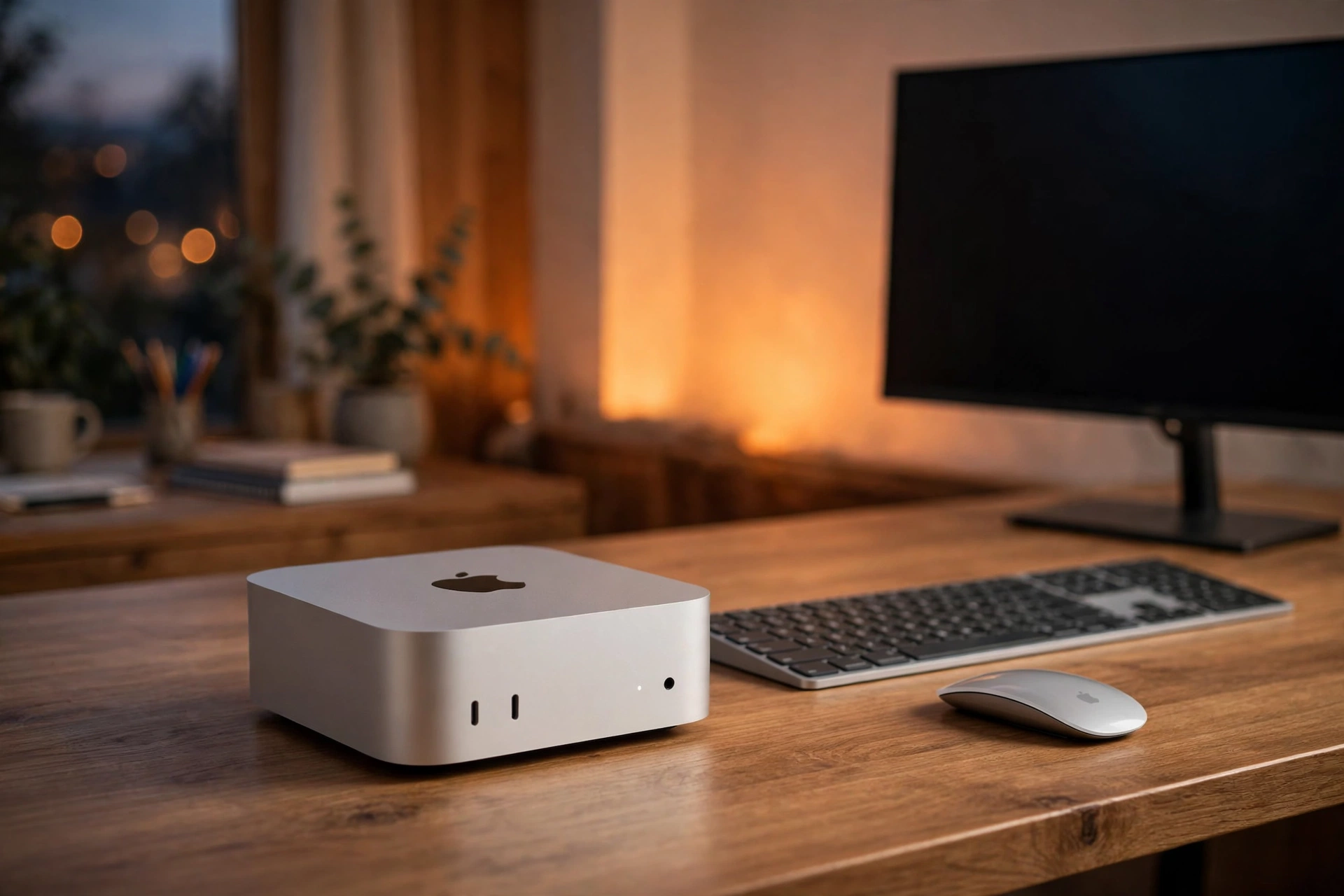
The Mac mini M6 arrived in August 2026 as the cheapest way into Apple’s current desktop lineup, starting at $899 in the US. Orders opened August 25, with the launch on September 22. It keeps the 5-inch square body from 2024, but the silicon is new: a first-generation 2-nanometer M6 chip, or a faster M5 Pro on top.
That small box covers a wide range, from a home office machine to a three-display workstation and even a node in a local AI cluster. MacRumors calls this the best time to buy, with the machine at the start of its product cycle.
The Short Version
- Four stock configs: M6 models at $899, $1,099 and $1,299 in the US; one M5 Pro model at $1,699.
- M6 highlights: 2nm chip, 12-core CPU and GPU, 16GB base memory, up to 32GB and 2TB storage.
- M5 Pro highlights: up to 18-core CPU and 20-core GPU, up to 64GB memory, 8TB storage, Thunderbolt 5.
- No extras in the box: no display, keyboard, or mouse. You supply your own.
- Timing: the August 2026 refresh puts the Mac mini at the start of its cycle.
The Bigger Picture
The Mac mini M6 matters because it is the cheapest door into the Mac, and the only Mac desktop that lets you bring your own screen. Buyers who own a monitor, keyboard, and mouse pay only for the computer. Apple also raised the starting price to $899, up $100 from the M4 mini. European equivalents run roughly 775, 945, 1,120, and 1,460 euros, approximate only. The design is unchanged: same silver enclosure, vented foot, and bottom power button, 5 inches square, 2 inches tall, 1.5 pounds for the M6 and 1.6 pounds for the M5 Pro.
Mac mini M6 Price: What Each Config Costs
Apple sells four stock configurations: three with the M6 chip and one with the M5 Pro.
The $200 step from base to mid buys only storage, 256GB to 512GB, the easiest upgrade to justify. The next $200 step buys memory, 16GB to 24GB, for heavy multitaskers. Build-to-order stretches both chips further: the M6 takes up to 32GB and 2TB, while the M5 Pro takes up to 64GB and 8TB. Choose memory at purchase, since it cannot be added later.
Mac mini M6 vs M5 Pro: The Chip Split
The M6 is Apple’s first 2-nanometer chip, with a 12-core CPU and a 12-core GPU. Apple says up to 4 times faster AI performance, up to 2 times faster graphics, and up to 4.8 times faster overall than the M4 Mac mini. Those are Apple claims, not lab results. It carries a dual 16-core Neural Engine, Neural Accelerators in each GPU core, and up to 170GB/s of bandwidth; the base model runs at 153GB/s.
The M5 Pro is built on a 3-nanometer process and scales higher: up to an 18-core CPU and up to a 20-core GPU, with an enhanced shader core and third-generation ray tracing. Apple says it runs up to 4 times faster than the M4 Pro. It supports up to 64GB of memory with 307GB/s of bandwidth, nearly double the M6 ceiling, with a standard 16-core Neural Engine. Both chips share a media engine covering ProRes, H.264, HEVC, and AV1.
The split is clear. The M6 wins on process and Neural Engine design, while the M5 Pro wins on cores, memory, and bandwidth. For everyday work the Mac mini M6 has more than enough power; for video editing and large AI models, the M5 Pro pulls ahead. The M5 Pro arrived because Apple has no M6 Pro chip planned, per MacRumors.
Mac mini M6 Displays, Ports and Connectivity
The Mac mini M6 supports up to three displays: two at 6K and 60Hz plus one at 5K and 60Hz, or an 8K display at 60Hz beside a 5K screen; the M5 Pro can run all three at 6K and 60Hz. Ports are generous: two front USB-C ports at up to 10Gb/s, and three rear Thunderbolt ports. The M6 uses Thunderbolt 4 at up to 40Gb/s, while the M5 Pro uses Thunderbolt 5 at up to 120Gb/s. An HDMI 2.1 port, 2.5Gb Ethernet configurable to 10Gb, and a 3.5mm headphone jack complete the rear.
Thunderbolt 5 brings two extras. Mac minis can be clustered to run large AI models on device, and Genlock through USB-C syncs the machine with a display and a camera, including the iPhone 17 Pro. Neither matters to most home buyers. Connectivity runs on Apple’s N1 chip, with Wi-Fi 7, Bluetooth 6, and Thread. Wi-Fi 7 pays off only with a Wi-Fi 7 router and a fast plan.
Mac mini vs Mac Studio vs iMac
The Mac mini is Apple’s most affordable desktop; the Mac Studio sits above it for intensive work, and the iMac bundles a screen.
The Mac Studio costs far more and targets professionals who need M5 Max or M5 Ultra chips and up to 512GB of memory; its top model lists at $22,299. If your work fits in 64GB of memory and three displays, the Mac mini M6 covers it for a fraction of the price. The iMac M6 suits buyers who want everything in one purchase, but you pay for the display.

Which Config Should You Buy
The choice is simpler than the spec sheets suggest: spend on storage and memory before the Pro chip, because the Mac mini M6 already handles everyday work with room to spare.
- Pick the M6 if: you browse, write, stream, and run office apps; you already own a monitor and peripherals.
- Pick the M6 with 24GB if: you keep many apps and tabs open; you edit photos or light video.
- Pick the M5 Pro if: you edit video, model in 3D, or run large AI models; you need up to 64GB of memory or 8TB of storage.
- Skip the M5 Pro if: your heaviest task is a web browser.
Chip performance is only one factor. Screen quality, desk space, and peripherals matter more than a benchmark gap.
What to Watch Next
Apple plans M7 and M7 Pro Mac minis as soon as 2027, per MacRumors, but that is a reported plan, not a confirmed launch. Waiting a year means a year without the machine.
The M4 model saw record lows before the refresh, and a sale on the Mac mini M6 can beat the list price.

Quick Answers
- Is the Mac mini M6 a good buy in late 2026? Yes, for most desktop buyers. It starts at $899 in the US.
- What is the difference between the Mac mini M6 and the M5 Pro Mac mini? The M6 uses a newer 2nm process, while the M5 Pro offers more cores, up to 64GB of memory, 8TB of storage, and Thunderbolt 5.
- Does the Mac mini M6 come with a display? No. Apple ships no display, keyboard, or mouse. You supply your own.
- Can the Mac mini M6 run three displays? Yes. Two at 6K and 60Hz plus one at 5K and 60Hz, or an 8K display at 60Hz.
- Should I buy the Mac mini M6 or wait for the M7? Buy now. The M7 is only a reported plan for 2027.
The Takeaway
The Mac mini M6 is the right Mac desktop for most buyers. The $1,099 model with 512GB of storage is the sweet spot; the $1,299 model with 24GB suits heavy multitaskers. The M5 Pro is a specialist tool, not a default upgrade. At $899 it undercuts every other current Mac desktop. Buy the config that fits your work and skip the upgrades you will never use.
Sources
- MacRumors, Mac mini roundup, updated September 22, 2026. Specs, prices, display support, and the M7 report.
- Apple, Mac mini product page, accessed November 1, 2026. M6 and M5 Pro performance claims, design, and Mac Studio figures.
Methodology note: performance multiples are Apple claims (MF), not lab results. No independent benchmarks were available. Prices are US list prices from August 2026; euro figures are approximate conversions only.